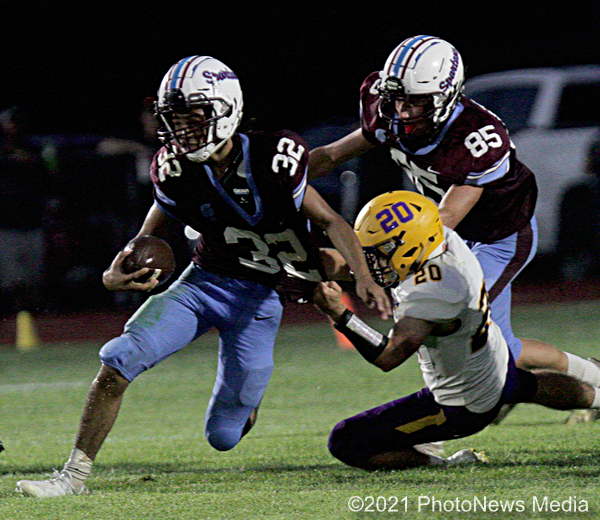
SJO's Isaiah Moore helps a teammate bring down Prairie Central's Camden Palmore during fourth quarter action. (Photo: PhotoNews Media/Clark Brooks)
Isaiah Moore finds open pasture on 42-yard kick return for the Spartans. The senior picked up 107 yards for the night returning kickoffs and punts for the Spartans. His shortest run was 14 yards, his longest was this 42-yard run. (Photo: PhotoNews Media/Clark Brooks)
SJO's Owen Birt hangs on to Prairie Central's Drew Fehr during a play in the second quarter. The Hawks outscored St. Joseph-Ogden 20-14 at the midpoint of the game. (Photo: PhotoNews Media/Clark Brooks)
Spartans' Ethan Vanliew puts his shoulder into Hawks' Drew Fehr to help teammate Bryson Helfrich make a tackle during second quarter action of the game. Just a TD away from winning their first game of the season, SJO fell at home to Prairie Central, 34-28. (Photo: PhotoNews Media/Clark Brooks)
Lineman Conrad Miller gets physical while playing on the offensive line against the Hawks. (Photo: PhotoNews Media/Clark Brooks)
Seniors Griffin Roesch and Keaton Nolan (right) celebrate an SJO touchdown. Nolan found the end zone on a 25-yard Evan Ingram pass in the second quarter to narrow the Hawks' lead to eight points, 20-12. Later, the senior hauled in a second pass on a 10-yard play as time expired at the end of the third quarter. (Photo: PhotoNews Media/Clark Brooks)
A member of the SJO Maroon Platoon cheers after her football team puts another six points on the scoreboard in the second half. (Photo: PhotoNews Media/Clark Brooks
Senior Coby Miller reacts to the Spartans' third loss of the season as he walks of the field. Miller finished the night with just 26 rushing yards and 18 more from three passes. (Photo: PhotoNews Media/Clark Brooks)
Playing the roll of a valiant prince, Elijah Weinman performs with the SJO Marching Band during halftime show. (Photo: PhotoNews Media/Clark Brooks)
Flag girl Alyssa Shoviak performs during the SJO Marching Band's halftime performance. (Photo: PhotoNews Media/Clark Brooks)
Members of the SJO Marching Band reed section play during halftime. The band performed two numbers from this year's competition routines. (Photo: PhotoNews Media/Clark Brooks)
St. Joseph-Ogden junior Aidan McCorkle drags down Prairie Central quarterback Owen Rafferty for a loss. (Photo: PhotoNews Media/Clark Brooks)
Assistant coach and St. Joseph-Ogden football alum Nick Bialeschki passes along saged advice to junior defensive lineman Peyton Sarver. (Photo: PhotoNews Media/Clark Brooks)
Tyler Burch runs the ball back 28 yards on a punt return for the Spartans. The explosive junior speedster posted 106 yards on special team returns on Friday. (Photo: PhotoNews Media/Clark Brooks)
Joe Frasca boots the ball deep in the second half after a SJO touchdown. The Spartans scored four times during this week's game, doubling the sophomore's time on the field over the previous two weeks combined. (Photo: PhotoNews Media/Clark Brooks)
Keaton Nolan sprays his face with water during a timeout in the second quarter. The senior finished with 102 all-purpose yards in this season's home game against the Hawks. (Photo: PhotoNews Media/Clark Brooks)
St. Joseph-Ogden cheerleader Kyle Meccoli helps lead fans with a cheer during the fourth quarter. This season's cheer squad features 21 students under the direction of first year head coach MiReena Burris. (Photo: PhotoNews Media/Clark Brooks)
St. Joseph-Ogden defenders Alex Funk and Jett Morris wrap up Prairie Central running back Drew Fehr. Fehr, who scored twice during the week three conference game, tallied 152 yards on 25 carries against the Spartans. (Photo: PhotoNews Media/Clark Brooks)
An SJO cheerleader watches her team's football games between cheers. (Photo: PhotoNews Media/Clark Brooks)
Quarterback Evan Ingram looks for an open receiver as he drops back to pass during the second half. The senior completed 15 of the 23 passes for 203 yards. Three of the completions (Photo: PhotoNews Media/Clark Brooks)
In a triangle match with Tri-Valley and Fisher, the SJO golf team finished in first place with 180 points after the nine-hole competition at Indian Springs in Saybrook.
Jacob Kern shot a match-best of 40 strokes to lead the field on Thursday. Maddux Carter finished in second place with a 43 on the par-36 course.
McGwire Atwood (46), Logan Smith (51), Jack Robertson (50) and Andrew Beyers (64) contributed to the Spartans' ninth win of the season.
Uni-High blanks Arthur Christian
Teo Chemla collected a hattrick to help the Illineks roll over the Conquering Raiders, 7-1. The junior standout was also credited with two assists.
Uni-High scored five goals in the first half. Luca Zepeda-Flores, Henry Wang and Arya Thirodira put the ball between the posts along with Chemla's first two in the first 45 minute period. Noah La Nave (2 assists) added another goal at the 51-minute mark before the final score by Chemla.
Uni keeper Arjun Kala made six saves.
St. Joseph-Ogden tennis falls at Centennial, 9-0
The Spartan tennis team dropped all nine matches on the road against Champaign Centennial on Thursday. Doubles duo Hope Rajlich and Kelsey Martlage made a valiant effort for SJO at number one doubles against the Chargers' Sandhya Subbiah and Grace Kahler. Katie McDermott and Emma Rydell also made a strong showing for the Spartans at number three doubles.
Box Score:
After dropping a dramatic three-setter to visiting Champaign Central 2-1 on Tuesday evening, the St. Joseph-Ogden volleyball team cruised past the Oakwood volleyball team, 25-7, 25-6 on Wednesday evening.
Addie Roesch led the Spartan attack with eight kills. Senior Kennedi Burnett pounded four aces and seven kills against the visiting Comets.
SJO got 10 digs from senior Hannah Fox. Burnett was also credited with 10 digs, Roesch with two, and setter Becca Steinbach, who had 18 assists, tallied six digs.
The Spartans host Hoopeston Area on Monday, and Danville High School on Wednesday next week.
Brown scores five goals for Cornjerkers
Hoopeston Area senior Ben Brown scored all five goals in his team's 5-0 shutout against Bismarck-Henning.
Hoopeston hosts the Conrnjerker Classic featuring teams from Monticello, Iroquois West, Grant Park, Bloomington Central Catholic, Oakwood-Salt Fork, and St. Joseph-Ogden. The championship and third-place games will start at 4:00p on Saturday.
Unity soccer team suffers Labor Day loss
The Urbana girls tennis team picked up another team win on the road at Watseka yesterday after a 6-3 decision.
Matika Pounginjai, Alisa Tangmunarunkit, Eisla Madigan, and Ashton Peters won their varsity singles matches against the Warriors' top players.
Box Score:
The Unity soccer team fell 8-2 on the road to Judah Christian on Thursday.
Nolan Romole and Teaguen Williams scored one goal each, but it was enough to hold off the Lions, who scored six unanswered goals in the second half of the non-conference contest.
(NAPS) — It's no secret that pets are like family—holiday traditions included. This Halloween bring your pups in on the spooky fun by decking them out in a scary cute costume and training them to be the most polite trick-or-treater on the block.From fun costumes to virtual and in-person dog training, Petco has everything a pet parent needs to make Halloween a howling good time for the whole family.
Photo provided
Whether your family is planning to trick-or-treat or celebrate at home, here are five surefire ways to help prep your pet:
• Plan Your Pet's Look: Petco’'s latest "Bootique" collection features an array of ready-to-wear Halloween apparel, accessories, matching costumes and more. Dogs can play a different role in the animal kingdom as a shark or cow or even twin with their human as tigers. From easy-on options to full-body costumes, the "Bootique" is full of costumes designed with care so all types of pets and preferences can find their match.
• Take Precautions: Once the whole pack has picked their costumes, have a pre-Halloween dress rehearsal so your pup can get used to the outfit and accustomed to everyone else’s.
Before any festivities begin, triple-check your pet's costume for any hazardous materials that could be chewed or cause choking. To stay safe after sundown, every Halloween look should also include reflective gear and proper pet identification.
• Learn the Training Basics: Basic skills such as "sit" and "stay" can make all the difference for dogs when it comes to safely interacting with trick-or-treaters and helping your pet navigate the Halloween commotion. "Drop it" or "leave it" are additional key training cues in case your curious pup sniffs or picks up any human treats—such as chocolate—that could be toxic to dogs. Preemptive Petco positive dog training can be helpful to teach your pet proper Halloween etiquette and keep the holiday fun for all.
• Offer Treats in Moderation: Although it's tempting to indulge pets around the holidays, it’s important to remember that no more than 10% of a pet’s daily calorie intake should be from treats. Help keep pets energized for the Halloween festivities by giving them protein-packed treats, such as Wholehearted stick treats for dogs or new freeze-dried treats for cats, or find other ways to celebrate the season with them through fun seasonal toys such as a plush pumpkin spice latte or rope toy. To help keep pets feeling their best year-round, give them the ultimate treat of Vital Care for just $19 a month to enjoy savings on grooming, vet exams and more.
• Create a Spook-Free Safe Haven: Between constant doorbell rings, unknown trick-or-treaters and spooky costumes, Halloween festivities can add to pets’ anxiety. The best way to help your pet is by learning to identify their anxious behavior and which calming tactics work best for them. Petco offers an array of calming aids, chews or oil diffusers to help keep pets at ease. Background noise from either music or the TV can help drown out unusual sounds, but it's also a good idea to give pets a quiet room away from the action.For more tips on how to safely celebrate Halloween with the whole family—cats, bearded dragons, and guinea pigs included—check out a Petco pet care center or petco.com/halloween.
About the author - Darris Cooper, CPDT-KA, is the National Dog Training Manager at Petco. He has worked in the industries of animal training and behavior, pet lifestyle and broadcast journalism, and has been a professional dog trainer for more than 10 years.
SJO's Zachary Dahman heads the ball away Fisher's Jaden Recker during their match on Tuesday before a pop-up summer storm soaked the area. St. Joseph-Ogden fell 2-0 to the visiting Bunnies. (PhotoNews Media/Clark Brooks)
St. Joseph-Ogden's Addie Roesch tips the ball over Champaign Central blockers Olivia Jackson (left) and Olivia Gustafsson on Tuesday, September 7. The Spartans fell after a thrilling three-set match, 25-22, 24-26, 16-25. Roesch finished the night with 10 kills and 15 digs for SJO. (PhotoNews Media/Clark Brooks)
Three seniors turned in 3-mile times under 18 minutes at the annual Cow Chip Classic in Chrisman on Saturday to power the St. Joseph-Ogden cross country team to a first-place meet finish.
Luke Stegall finished the course in 17:00.1 and in fourth place in the race's top flight. An SJO runner finished first the remaining six flights. Charlie Mabry clocked 11.6 seconds slower time than his teammate Flight #2 and Elijah Mock crossed the finish line at 17:36.4.
Sophomore Carson Maroon, juniors Ethan Blackburn and Peyton Wendell, and soph Aiden Armstrong placed first in each of their flights.
Behind the Spartans in the team standings, Monticello finished in second place, Tuscola in third and Unity took fourth to round out the top four places.
SJO squad plces third at the Cow Chip
Collecting 145 team points on Saturday, the St. Joseph-Ogden girls cross country squad brought home third-place honors from the Cow Chip Classic at Chrisman.
Newcomer Savanna Franzen, a freshman, led the Spartans' effort finishing her race in the #1 Flight in 19 minutes and 50.5 seconds.
A senior-dominated team, the seven runners' total time added up to 2:29:12.2 at the early season race. Ava Knap (19:55.8), Kailyn Ingram (20:31.4), Chloe Burkhalter (21:49.9), Addie Allen (22:09.9), Taryn Sexton (22:24.6), and Maddison Clampitt (22:29.9) represented SJO at this season's meet.
Chrisman - The Rockets' girls cross country team clocked in a minute and 22 seconds ahead of fellow Illini Prairie Conference member Monticello to win the 2021 Cow Chip Classic team title. Seven runners, each running in an individual flight, turned in a consolidated time of 2:24:13.2.
Wearing bib number 938, Unity's Olivia Shike led the team with the shortest time in the 3-mile race crossing the finish line at 19:57.0. Shike was one of four sophomores who ran for the maroon and gray.
Also running in this year's race were seniors Harper Hancock and Malia Fairbanks, who finished the course at 20:38.4 and 20:48.9, respectively. Sophomores Raegan Stringer and Erica Woodard ran sub 21-minute times while Caelyn Kleparski missed the mark by .2 of second at 21:00.1. Meanwhile, freshman Emily Decker turned in a time of 20:49.7 running in Flight #6.
Rockets boys finish in fourth place
Chrisman - Seven Unity harriers banded together to finish in fourth place at the Chrisman Cow Chip Classic on Saturday. Thomas Cler, Brendan Graven, Bryson Denney, Alex Mowrer, Nolan Miller, Clayton Jamison, and Isaac Ruggieri turned in a cumulative time of 2:16:06.0.
The St. Joseph-Ogden (2:04:33.4) boys squad took the team meet title with Monticello (2:08:56.4) in second and Tuscola (2:13:16.7) finish one spot ahead of the Rockets in third.
Cler was the top finisher for the Rocket boys squad with an individual time of 18:18.2.
Annie Walker woke up one morning in 2019 with little recollection of the night before. She had bruises on her arms, legs, wrist and lower abdomen.
"But I literally had no idea what had happened," she said. "And, for days, I was trying to put the pieces together."
She knew she had gone to a Sacramento, California, bar and restaurant with a group of people, and she remembered drinking there and being left alone with the man she’d later identify as her rapist. But not much else.
Memories she couldn't summon that first morning gradually came into focus over days and weeks, she said. The emerging details included what the man had been wearing, and the way he shoved her against the bar. One week after the attack, she reported the crime to the Sacramento County Sheriff's Department.
Then, in the days after making the report, another wave of memories surfaced — she recalled, vividly, that the man had raped her and had a weapon.
"I knew that there was a gun at my neck, at my back," she said. "It was just clear."
The detectives gave her a hard time, she said, when she called to report that she had remembered that her attacker had a gun. The Sacramento detectives assigned to Walker's case didn’t seem to understand why she couldn’t remember all the details right away.
Walker’s alleged perpetrator was never arrested.
"I felt like I was just extremely cross-examined on the phone. Like, 'Why didn’t you remember a gun? That's, like, a really important thing.'"
Sexual assault survivors say interactions with law enforcement can be so intense, and so unsympathetic, that they add secondary trauma. Reporting a rape can be especially traumatic when officers cast doubt on victims’ stories.
But it doesn't have to be, say scientists and scholars of criminal justice. If police gain a deeper understanding of what’s going on in the brain during and after a rape, they can change the way they approach rape cases and avoid making survivors feel blamed or disbelieved.
Scientists who study trauma and memory say it's common for sexual assault survivors — as well as survivors of other serious traumas — to be unable to recall an attack fully. They might remember certain facts but not others, or struggle to recall events in the correct sequence.
When law enforcement officers aren't aware of the neuroscience of trauma, or have no training to deal with it, there’s a tendency to dismiss or disbelieve victims who experience memory gaps, according to scholars and advocates for sexual assault survivors.
"There’s a real danger when investigators are asking people for information that was never encoded or has been lost," said Harvard University psychologist Jim Hopper. "They can stress out the victim, leave them feeling misunderstood, incompetent, not wanting to further engage with the investigation."
Walker's alleged perpetrator was never arrested. And she's still frustrated with the way detectives put pressure on her to remember details during the investigation.
The Brain in Survival Mode
When confronted with a crisis, the brain often activates its "fight, flight or freeze" response. In these scenarios, the brain’s "defense circuitry" takes over, explained Hopper. The prefrontal cortex, which is responsible for logical decision-making, is no longer in control and, instead, the areas of the brain responsible for scanning for danger take charge.
"And that's what people are running on" when trauma happens, Hopper said.
Some people respond by mentally "dissociating," or disconnecting from their physical selves. That survival response affects the ability to absorb what’s happening around them, Hopper said.
Studies on memory and recall during a traumatic event describe two types of details: central and peripheral. Central details are those that capture our attention and evoke emotions in the moment, such as a location. Peripheral details are those that a survivor might not have been paying attention to during the crisis, such as something the perpetrator said or whether other people were present. Central details tend to be stored more reliably and for longer than peripheral details.
Every day in courtrooms around the country, [defense attorneys] attack and question the credibility of victims
Sometimes survivors are unable to answer what might seem like a simple question if it involves a peripheral detail like the color of the attacker’s shirt. And Hopper said that can make officers suspicious.
Hopper, who gives legal testimony in sexual assault cases, said victims are often held to unfair standards, even compared with other trauma survivors.
"Every day in courtrooms around the country, [defense attorneys] attack and question the credibility of victims of sexual assault for having the same kind of memories that soldiers have for their combat experiences," he said.
Victim advocates and criminal justice scholars say it’s important for detectives to be open to anything a survivor might say, whenever they say it — even if those details were not available in an initial report — because the information survivors provide later can be helpful for solving the crime.
Maintaining an Open Mind
Nicole Monroe, a police detective in Elk Grove, a suburb of Sacramento, said she and some of her colleagues have gotten additional education on brain science, and it has changed the way they approach sexual assault cases.
Monroe tells victims she works with that more memories will continue to surface in the days, weeks and even months to come.
"Smells will come back. Sights will come back. When you think of these things, give me a call and let me know, so that it can be added,” Monroe said. "Because little things like that are going to make a difference."
Traditionally, law enforcement officers are trained to conduct an interrogation that may involve drawing out specific details, usually in chronological order.
"The expectation is someone is supposed to come in, sit down, they’re supposed to be ready to talk, they’re supposed to know what to talk about," said Carrie Hull, a former detective with the Ashland Police Department in southern Oregon. "They're going to tell you what happened to them from the beginning, through the middle, and then the end. That is a very traditional understanding."
Hull is now a consultant for police departments, and part of her work involves advocating for the adoption of a technique known as Forensic Experiential Trauma Interviewing, or FETI. The training can help law enforcement learn how to ask questions differently: with empathy, patience and an informed understanding of how a traumatized brain makes memories and recalls them. Training in the technique is available through an online course, but it’s not a mandatory requirement for most police departments.
People who take Hull's course learn specific strategies for helping someone resurface a relevant memory that he or she may not have had access to when they first walked into the interview room. Hull said FETI discourages counterproductive practices such as paraphrasing, changing the victim’s words, interrupting or giving advice.
Hull said the overarching goal of trauma interviewing is to first "collect the dots, then connect the dots." In other words, simply interview the victim about what happened. The sharper, more aggressive investigative tactics can wait.
There isn’t research proving that law enforcement departments who take this training solve more rape cases. But victim advocates and scholars said it's a best practice that could make working with police a more positive experience for victims and, eventually, help bring more perpetrators to justice.
"If I had my way, every one of them would be doing this," said Dave Thomas, a program officer with the International Association of Chiefs of Police.
Annie Walker is still struggling to recover from her sexual assault, but it's complicated because she’s also healing from the way law enforcement handled her case. She said both police officers and survivors need more education on the way trauma affects memory.
She said if survivors knew what to expect in terms of memory issues, it wouldn’t be so frustrating. "They need to feel like the way that things are happening in their mind is normal. Normal for them."
This story is from a partnership that includes CapRadio, NPR and KHN.
KHN (Kaiser Health News) is a national newsroom that produces in-depth journalism about health issues. Together with Policy Analysis and Polling, KHN is one of the three major operating programs at KFF (Kaiser Family Foundation). KFF is an endowed nonprofit organization providing information on health issues to the nation.
(Family Features) - Although the COVID-19 pandemic turned the world upside down, the rapid development of multiple vaccines has spurred hope that treatments – or even potential cures – may be found for other devastating conditions. One such candidate is Alzheimer’s Disease.
Early signs of Alzheimer’s include trouble remembering new information, solving problems or completing familiar tasks. As the disease progresses, disorientation, confusion, significant memory loss and changes in mood or behavior may become apparent. Physical symptoms may include difficulty speaking, swallowing or walking.
Impact of Alzheimer’s
Among people aged 65 and older, 1 in 9 (11.3%) has been diagnosed with Alzheimer’s Disease, meaning more than 6 million Americans live with it. Worldwide, the World Health Organization estimates there are nearly 50 million people living with dementia, and Alzheimer’s likely accounts for 60-70% of those. By 2050, this number could rise as high as 13 million. Less commonly noted are the numbers of early-onset (under 65 years old) Alzheimer’s patients within those figures. Up to 9% of global Alzheimer’s cases are believed to be early onset, according to the World Health Organization.
According to a Harvard School of Public Health survey, Alzheimer’s is second only to cancer among America’s most feared diseases. However, data from the Alzheimer’s Association shows Alzheimer’s is the sixth-leading cause of death in the United States, a rate higher than breast cancer and prostate cancer combined.
Beyond the personal impact for those battling the disease and their loved ones, Alzheimer’s Disease also takes a significant economic toll. The Alzheimer’s Association predicts that in 2021, Alzheimer’s and other dementias will cost the nation $355 billion. By 2050, these costs could exceed $1 trillion if no permanent treatment or cure for Alzheimer’s is found. At the same time, more than 11 million Americans provide unpaid care for people with Alzheimer’s and other dementias, an estimated 15.3 billion hours of care, valued at nearly $257 billion.
Treatment Options
While there hasn't been enough significant progress in discovering a treatment or cure in the more than 100 years since Alzheimer’s was first identified in 1906, early diagnosis and treatment may improve the quality of life for patients. The disease affects each patient differently, so therapies vary widely depending on how far it has progressed and which symptoms are most prevalent. Some therapeutic approaches can address symptoms like sleep disruption and behavior while medication may be beneficial for treating other symptoms.
Founded in 2016 by Milton “Todd” Ault III, Alzamend Neuro, a preclinical-stage biopharmaceutical company, has been actively seeking a cure for Alzheimer’s and concentrates on researching and funding novel products for the treatment of neurodegenerative diseases and psychiatric disorders. With two products currently in development, the company aims to bring these potential therapies to market at a reasonable cost as quickly as possible.
Ault’s stepfather is currently battling Alzheimer’s, his mother-in-law died from the disease and he has three other family members suffering through it.
“Even though work has been done to find a cure for Alzheimer’s, to me it hasn’t been a full-court press,” said Ault, whose many personal encounters with Alzheimer’s have further fueled his passion to find a cure. “While there are no profound treatments today for Alzheimer’s disease, we believe we can change that.”
Practical Ways to Fast-Track a Cure
Some basic changes in the approach to disease research could accelerate progress for diseases like Alzheimer’s, said Milton “Todd” Ault III, founder of Alzamend Neuro.
Ault believes recent advancements in vaccines and medical technology, combined with these five approaches, can help advance the search for a cure for Alzheimer’s disease and other dementias.
Encourage public-private partnerships
The collaboration of government agencies and private industries was integral to the COVID-19 vaccine development. The cross-industry partnerships enabled a vaccine to get to market in less than one year despite detractors. Ault believes this model can be replicated for other diseases and conditions.
Diversify the search
Because of its complexity, a cure for Alzheimer’s will require expertise from a broad range of organizations including health and defense, biopharmaceutical firms, academic experts and those involved in Operation Warp Speed, the federal effort that supported multiple COVID-19 vaccine candidates simultaneously to expedite development.
Share standards and data
Focusing on a shared goal is vital to succeeding. This means looking for ways to share standards and collaborate with colleagues and competitors regardless of proprietary data, patents and other limitations.
Become the catalyst for a cure
When political will and government funding are insufficient or unable to drive change, the private sector can inspire action.
“The progress we are making is a result of the private investment dollars we secured and the way we have applied strategy and tenacity that comes from a successful business record,” Ault said.
Learning from past successes
Aside from the result, there is a great deal to learn from the successful development of past drugs and vaccines. Social awareness and cultural demand are potential ways to stimulate faster production and approvals between public and private entities.
To learn more about treatments and therapies in development visit alzamend.com .
(Family Features) - Finding time for a family meal during fall means navigating busy schedules full of school, demanding jobs, fun social events, sports practices to pick up the kids from, girls' nights out, and side-hustles to explore. Squeezing in filling dinner together calls for an easy dish that takes less than an hour so you can catch up with loved ones or do the things to help you live life to the fullest.
Let your oven do the work for you with this Build-Your-Own Sausage Foil Packet Dinner recipe that requires just 10 minutes of prep before 30 minutes of baking, leaving you plenty of time to help little ones with homework. It all starts with Coleman Natural Uncured Polish Kielbasa, a traditional Polish sausage rope smoked and fully cooked so all you need to do is slice into 1/2-inch pieces and toss together with veggies and seasonings. You can feel good you are serving pork sourced from American family farms that raise their animals crate-free with no antibiotics or added hormones ever.
An added benefit of this simple recipe is that it’s customizable, allowing you to substitute your family’s favorite flavors to satisfy everyone at the table. Or, if your loved ones are easily pleased and open to a variety of ingredients, you can try different veggies each time so it tastes like a new dish over and over again.
Build-Your-Own Sausage Foil Packet Dinner
Prep time: 10 minutes
Cook time: 30 minutes
Servings: 4
1 package Coleman Natural Uncured Polish Kielbasa, sliced 1/2-inch thick
2 cloves garlic, minced
2 ears corn, each cut crosswise into four pieces
2 large tomatoes, chopped
1 medium red onion, thinly sliced
1 pound Yukon Gold potatoes, chopped into 1-inch pieces
2 tablespoons extra-virgin olive oil
salt, to taste
pepper, to taste
2 tablespoons parsley, chopped
Preheat oven to 425 F.
Cut foil into four sheets about 12 inches long.
Divide kielbasa, garlic, corn, tomatoes, onion and potatoes evenly over foil sheets. Drizzle with oil then season with salt and pepper, to taste. Toss gently to combine.
Top each packet with parsley and fold crosswise over kielbasa and vegetable mixture to completely cover food. Roll top and bottom edges to seal.
Place foil packets on baking sheet and bake 30 minutes.
Variations: Customize ingredients for personal preferences. Use broccoli in place of corn or substitute peppers for onions.
Visit ColemanNatural.com/Recipes to find more fall meal inspiration.
Meggan Ingram was fully vaccinated when she tested positive for COVID-19 early this month. The 37-year-old’s fever had spiked to 103 and her breath was coming in ragged bursts when an ambulance rushed her to an emergency room in Pasco, Washington, on Aug. 10. For three hours she was given oxygen and intravenous steroids, but she was ultimately sent home without being admitted.
Seven people in her house have now tested positive. Five were fully vaccinated and two of the children are too young to get a vaccine.
As the pandemic enters a critical new phase, public health authorities continue to lack data on crucial questions, just as they did when COVID-19 first tore through the United States in the spring of 2020. Today there remains no full understanding on how the aggressively contagious delta variant spreads among the nearly 200 million partially or fully vaccinated Americans like Ingram, or on how many are getting sick.
The nation is flying blind yet again, critics say, because on May 1 of this year — as the new variant found a foothold in the U.S. — the Centers for Disease Control and Prevention mostly stopped tracking COVID-19 in vaccinated people, also known as breakthrough cases, unless the illness was severe enough to cause hospitalization or death.
Individual states now set their own criteria for collecting data on breakthrough cases, resulting in a muddled grasp of COVID-19’s impact, leaving experts in the dark as to the true number of infections among the vaccinated, whether or not vaccinated people can develop long-haul illness, and the risks to unvaccinated children as they return to school.
If you’re limiting yourself to a small subpopulation with only hospitalizations and deaths, you risk a biased viewpoint.
"It’s like saying we don’t count,” said Ingram after learning of the CDC’s policy change. COVID-19 roared through her household, yet it is unlikely any of those cases will show up in federal data because no one died or was admitted to a hospital.
The CDC told ProPublica in an email that it continues to study breakthrough cases, just in a different way. "This shift will help maximize the quality of the data collected on cases of greatest clinical and public health importance,” the email said.
In addition to the hospitalization and death information, the CDC is working with Emerging Infections Program sites in 10 states to study breakthrough cases, including some mild and asymptomatic ones, the agency’s email said.
Under pressure from some health experts, the CDC announced Wednesday that it will create a new outbreak analysis and forecast center, tapping experts in the private sector and public health to guide it to better predict how diseases spread and to act quickly during an outbreak.
Tracking only some data and not releasing it sooner or more fully, critics say, leaves a gaping hole in the nation’s understanding of the disease at a time when it most needs information.
"They are missing a large portion of the infected," said Dr. Randall Olsen, medical director of molecular diagnostics at Houston Methodist Hospital in Texas. "If you’re limiting yourself to a small subpopulation with only hospitalizations and deaths, you risk a biased viewpoint."
On Wednesday, the CDC released a trio of reports that found that while the vaccine remained effective at keeping vaccinated people out of the hospital, the overall protection appears to be waning over time, especially against the delta variant.
Among nursing home residents, one of the studies showed vaccine effectiveness dropped from 74.7% in the spring to just 53.1% by midsummer. Similarly, another report found that the overall effectiveness among vaccinated New York adults dropped from 91.7% to just under 80% between May and July.
The new findings prompted the Biden administration to announce on Wednesday that people who got a Moderna or Pfizer vaccine will be offered a booster shot eight months after their second dose. The program is scheduled to begin the week of Sept. 20 but needs approval from the Food and Drug Administration and a CDC advisory committee.
No vaccine is 100% percent effective against transmission, health officials warned.
This latest development is seen by some as another example of shifting public health messaging and backpedaling that has accompanied every phase of the pandemic for 19 months through two administrations. A little more than a month ago, the CDC and the FDA released a joint statement saying that those who have been fully vaccinated "do not need a booster shot at this time.”
The vaccine rollout late last year came with cautious optimism. No vaccine is 100% percent effective against transmission, health officials warned, but the three authorized vaccines proved exceedingly effective against the original COVID-19 strain. The CDC reported a breakthrough infection rate of 0.01% for the months between January and the end of April, although it acknowledged it could be an undercount.
As summer neared, the White House signaled it was time for the vaccinated to celebrate and resume their pre-pandemic lives.
Trouble, though, was looming. Outbreaks of a new, highly contagious variant swept India in the spring and soon began to appear in other nations. It was only a matter of time before it struck here, too.
"The world changed," said Dr. Eric Topol, director of the Scripps Research Translational Institute, "when delta invaded."
The current crush of U.S. cases — well over 100,000 per day — has hit the unvaccinated by far the hardest, leaving them at greater risk of serious illness or death. The delta variant is considered at least two or three times more infectious than the original strain of the coronavirus. For months much of the focus by health officials and the White House has been on convincing the resistant to get vaccinated, an effort that has so far produced mixed results.
Yet as spring turned to summer, scattered reports surfaced of clusters of vaccinated people testing positive for the coronavirus. In May, eight vaccinated members of the New York Yankees tested positive. In June, 11 employees of a Las Vegas hospital became infected, eight of whom were fully vaccinated. And then 469 people who visited the Provincetown, Massachusetts, area between July 3 and July 17 became infected even though 74% of them were fully vaccinated, according to the CDC’s Morbidity and Mortality Weekly Report.
While the vast majority of those cases were relatively mild, the Massachusetts outbreak contributed to the CDC reversing itself on July 27 and recommending that even vaccinated people wear masks indoors — 11 weeks after it had told them they could jettison the protection.
And as the new CDC data showed, vaccines continue to effectively shield vaccinated people against the worst outcomes. But those who get the virus are, in fact, often miserably sick and may chafe at the notion that their cases are not being fully counted.
"The vaccinated are not as protected as they think," said Topol, "They are still in jeopardy."
The CDC tracked all breakthrough cases until the end of April, then abruptly stopped without making a formal announcement. A reference to the policy switch appeared on the agency’s website in May about halfway down the homepage.
"I was shocked," said Dr. Leana Wen, a physician and visiting professor of health policy and management at George Washington University. "I have yet to hear a coherent explanation of why they stopped tracking this information.”
The CDC said in an emailed statement to ProPublica that it decided to focus on the most serious cases because officials believed more targeted data collection would better inform "response research, decisions, and policy."
Sen. Edward MMarkey, D-Mass., became alarmed after the Provincetown outbreak and wrote to CDC director Dr. Rochelle Walensky on July 22, questioning the decision to limit investigation of breakthrough cases. He asked what type of data was being compiled and how it would be shared publicly.
It is unclear how often breakthroughs occur or how widely cases are spreading among the vaccinated.
"The American public must be informed of the continued risk posed by COVID-19 and variants, and public health and medical officials, as well as health care providers, must have robust data and information to guide their decisions on public health measures," the letter said.
Markey asked the agency to respond by Aug. 12. So far the senator has received no reply, and the CDC did not answer ProPublica’s question about it.
When the CDC halted its tracking of all but the most severe cases, local and state health departments were left to make up their own rules.
There is now little consistency from state to state or even county to county on what information is gathered about breakthrough cases, how often it is publicly shared, or if it is shared at all.
"We’ve had a patchwork of information between states since the beginning of the pandemic,” said Jen Kates, senior vice president and director of global health and HIV policy at Kaiser Family Foundation.
She is co-author of a July 30 study that found breakthrough cases across the U.S. remained rare, especially those leading to hospitalization or death. However, the study acknowledged that information was limited because state reporting was spotty. Only half the states provide some data on COVID-19 illnesses in vaccinated people.
"There is no single, public repository for data by state or data on breakthrough infections, since the CDC stopped monitoring them,” the report said.
In Texas, where COVID-19 cases are skyrocketing, a state Health and Human Services Commission spokesperson told ProPublica in an email the state agency was "collecting COVID-19 vaccine breakthrough cases of heightened public health interest that result in hospitalization or fatality only."
Other breakthrough case information is not tracked by the state, so it is unclear how often breakthroughs occur or how widely cases are spreading among the vaccinated. And while Texas reports breakthrough deaths and hospitalizations to the CDC, the information is not included on the state’s public dashboard.
"We will be making some additions to what we are posting, and these data could be included in the future," the spokesperson said.
I thought, ‘COVID is over and I’m going to Disney World,’
South Carolina, on the other hand, makes public its breakthrough numbers on hospitalizations and deaths. Milder breakthrough cases may be included in the state’s overall COVID-19 numbers but they are not labeled as such, said Jane Kelly, an epidemiologist at the South Carolina Department of Health and Environmental Control.
"We agree with the CDC,” she said, "there’s no need to spend public health resources investigating every asymptomatic or mild infection.”
In Utah, state health officials take a different view. "From the beginning of the pandemic we have been committed to being transparent with our data reporting and … the decision to include breakthrough case data on our website is consistent with that approach," said Tom Hudachko, director of communications for the Utah Department of Health.
Some county-level officials said they track as many breakthrough cases as possible even if their state and the CDC does not.
For instance, in Clark County, Nevada, home of Las Vegas, the public health website reported that as of last week there were 225 hospitalized breakthrough cases but 4,377 vaccinated people overall who have tested positive for the coronavirus.
That means that less than 5% of reported breakthrough cases resulted in hospitalization. "The Southern Nevada Health District tracks the total number of fully vaccinated individuals who test positive for COVID-19 and it is a method to provide a fuller picture of what is occurring in our community,” said Stephanie Bethel, a spokesperson for the health district in an email.
Sara Schmidt, a 44-year-old elementary school teacher in Alton, Illinois, is another person who has likely fallen through the data hole.
"I thought, ‘COVID is over and I’m going to Disney World,’" she said. She planned a five-day trip for the end of July with her parents. Not only had she been fully vaccinated, receiving her second shot in March, she is also sure she had COVID-19 in the summer of 2020. Back then she had all the symptoms but had a hard time getting tested. When she finally did, the result came back negative, but her doctor told her to assume it was inaccurate.
"My guard was down," she said. She was less vigilant about wearing a mask in the Florida summer heat, assuming she was protected by the vaccination and her presumed earlier infection.
On the July 29 plane trip home, she felt mildly sick. Within days she was "absolutely miserable." Her coughing continued to worsen, and each time she coughed her head pounded. On Aug. 1 she tested positive. Her parents were negative.
Now, three weeks later, she is far from fully recovered and classes are about to begin at her school. There’s a school mask mandate, but her students are too young to be vaccinated. "I’m worried I will give it to them, or I will get it for a third time," she said.
But it is doubtful her case will be tracked because she was never hospitalized. That infuriates her, she said, because it downplays what is happening.
"Everyone has a right to know how many breakthrough cases there are," she said, "I was under the impression that if I did get a breakthrough case, it would just be sniffles. They make it sound like everything is under control and it’s not."
Life is short. The best we can do, is the best we can do. If we are doing our best, then what more can we expect from ourselves and others? Most people are doing the best they can with the information and abilities they have.
There are some things we can change and some things we can’t. Learning to adjust or adapt with what we have and who we are often takes some time and effort. We are all born some place to someone. Some of us are raised with less than others and some of us are raised with more than others. Many have a lot to overcome to merely survive in life while others seem to have it easy.
Academics appear to come easier for some people while others have to study diligently just to make a passing grade. Some are lucky in life while others don’t seem so lucky.
One of my dear friends is a multi-millionaire. He has a great house, wife and business galore. Over the last few years a young son was killed in a car wreck. A daughter was killed in a wreck and another died from natural causes. Many who don’t know the tragedies and heartache that he has experienced assume that his life is great and free from pain. I know he would trade everything he has to have his children back with him. He continues to get up in the morning. He is still involved in his business, cares for his wife and cherishes his one remaining daughter. However, life is not as it may seem to some.
Another dear friend has prospered with a large family and a successful business. His life looked good until you get to know him better. One of his sons committed suicide in front of him a couple of years ago. Another son recently died in an accident. Within weeks of his son’s accident, a grandson was killed in a car wreck. His pain is great. He goes through the motions day by day trusting God with his life and remaining children. It is difficult to understand why his family has suffered so much in recent days. Tears flow when he begins to talk about what his family has suffered.
Life is not so easy to figure out. We think we have the answers and then later in life realize we don’t know much at all. We thought we had life all figured out when we were very young but throughout the years life throws things at us that we can’t possibly see coming.
Today, let’s all consider others. Be kind to our neighbors, acquaintances and people we meet along the way. A lot of people are hurting from disease, death, unemployment, life’s tragedies and more. Don’t judge people by their appearances or their mistakes. Life is not only filled with good, but often pain that most never see.
What life seems to be and what life actually is are rarely the same.
Dr. Glenn Mollette is a syndicated American columnist and author of American Issues, Every American Has An Opinion and ten other books. He is read in all 50 states. The views expressed are those of the author and are not necessarily representative of any other group or organization.
This article is the sole opinions of the author and does not necessarily reflect the views of The Sentinel. We welcome comments and views from our readers. Submit your letters to the editor or commentary on a current event 24/7 to editor@oursentinel.com.
6-foot-2, 225-pound lineman Karson Richardson puts his shoulder into St. Joseph-Ogden's Jack Setterdahl while playing during the second half of their conference football game at Hicks Field. (Photo: PhotoNews Media/Clark Brooks)
Unity receiver Tyler Hensch and quarterback Blake Kimball celebrate a touchdown against visiting St. Joseph-Ogden on Friday. The Rockets beat the Spartans in Illini Prairie Conference action, 33-8. Next up, Unity travels to Illinois Valley Central to take on the Grey Ghost on Friday. Click here to see more photos from this game. (PhotoNews Media/Clark Brooks)
After he is flushed out of the backfield on his team's second snap of the game, Rocket QB Blake Kimball jets down the north sideline on his way to a 72-yard, first quarter touchdown. Kimball finished the night with 104 yards on nine carries and scored again later Unity's home game against the Spartans. (Photo: PhotoNews Media/Clark Brooks)
Rockets' Austin McDaniel cools off during a timeout against the Spartans. The senior defensive lineman veteran experience was crucial to his team ability to hold SJO to just 125 rushing yards. (Photo: PhotoNews Media/Clark Brooks)
St. Joseph-Ogden quarterback Evan Ingram looks down field to throw a long pass during the second half. Ingram finished the night completing 5 of 14 passes for 32 yards against the host Rockets. (Photo: PhotoNews Media/Clark Brooks)
Quarterback Blake Kimball is brought down by St. Joseph-Ogden's Bryson Helfrich on Unity's first offensive play in the first quarter during the Rockets' home game on Friday, September 3. On the next play Kimball dashed down the field to score the first of the team's five touchdowns. Unity went on to improved to 2-0 record after beating the visiting Spartans, 33-8. (Photo: PhotoNews Media/Clark Brooks)
SJO's Owen Birt leaps into action in an attempt to block a Unity extra point attempt in the fourth quarter. (Photo: PhotoNews Media/Clark Brooks)
Members of the Unity Dance Team entertain spectators while performing during halftime. (Photo: PhotoNews Media/Clark Brooks)
A member of the Unity marching band's flag corp twirls her flag around shoulders during Friday night's halftime performance. (Photo: PhotoNews Media/Clark Brooks)
Together with Sophia Stierwalt to her left, Drum Major Elise Johnson lead the Unity Rocket Marching Band during their halftime presentation. (Photo: PhotoNews Media/Clark Brooks)
A horn player marches with Unity marching band while playing the bands rendition of a Stevie Wonder tune during halftime. (Photo: PhotoNews Media/Clark Brooks)
Justice Wertz sheds a Unity tackler while trying to get the ball out of the SJO backfield during the fourth quarter. Wertz, a 5'-9', 135-pound running back, finished the road game with 9 yards after two touches on Friday. (Photo: PhotoNews Media/Clark Brooks)
St. Joseph-Ogden senior Austin Cotter tries to work his way past Unity's Karson Richardson during the second half of their game. (Photo: PhotoNews Media/Clark Brooks)
Unity senior Nate Nosler and a teammate wrap up St. Joseph-Ogden ball carrier Keaton Nolan. (Photo: PhotoNews Media/Clark Brooks)
After breaking away from would be tacklers Rowan Musselman and Alex Funk from St. Joseph-Ogden, Unity's Haidyn Hendricks picks up a few more yards on the fourth quarter play. Hendricks finished the game with a net 14 yards in his team's second home game of the season. (Photo: PhotoNews Media/Clark Brooks)
SJO's Bryson Helfrich moves to block a Unity lineman. In search of their first win of the season, Helfrich and the Spartans will host Prairie Central this coming Friday.(Photo: PhotoNews Media/Clark Brooks)
Finding a bit of green turf open, St. Joseph-Ogden's Keaton Nolan makes a quick cut to take advantage of the hole in Unity's defense. Nolan finished the game with 14 receiving-yards and 45 on his ground attack. (Photo: PhotoNews Media/Clark Brooks)
Unity receiver Tyler Hensch and quarterback Blake Kimball celebrate a touchdown against visiting St. Joseph-Ogden on Friday. The Rockets beat the Spartans in Illini Prairie Conference action, 33-8. Next up, Unity travels to Illinois Valley Central to take on the Grey Ghost on Friday. Click here to see more photos from this game.
After one week, the Unity football team earned enough votes in the Associated Press poll to move up to #4 in the Class 3A poll. Ranked one spot above the Rockets are their Illini Prairie Conference rivals, the Monticello Sages. The two teams are scheduled to meet on the gridiron in a regular-season finale on October 22.
In the preseason poll, Unity was tied at fifth on the list with Farmington. Meanwhile, the Sages entered the season at #3.
Here is a complete listing of the Class 3A rankings.
Class 3A
1. Wilmington (6) (1-0) 86 1
2. Princeton (3) (1-0) 75 4
3. Monticello (1-0) 68 3
4. Tolono Unity (1-0) 50 T5
5. Williamsville (0-1) 49 2
6. Byron (1-0) 39 7
7. Farmington (1-0) 35 T5
8. Nashville (1-0) 31 8
9. Montini (0-1) 17 10
(tie) Mt. Carmel, IL (1-0) 17 9
Others receiving votes: Paxton-Buckley-Loda 10, Benton 6, Carlinville 4, Peotone 3, Reed-Custer 2, Eureka 2, Fairbury Prairie Central 1.
Nolan Romle scored two of Unity's four goals in their home soccer match against Meridian on Thursday. The freshman's two scores, bookending a strike from Gabe Pound, gave the Rockets a 3-all tie leading heading into halftime.
Later, Meridian striker Spencer Uphoff broke the tie with an unassisted goal in the second half, but the Rockets refused to lie down thanks to junior Andrew Mowrer notching a penalty kick to retie the score, this time at four goals apiece.
With his first goal already under his belt in the first half, Hawks Micah McCoy scored the game-winning goal handing Unity a 5-4 loss.
Mason Davis made 13 saves on the day for the Rockets.
Still looking for their first win of the season, Unity (0-4) will play their next game, the team's first road match, on Monday, September 6 at Warrensburg-Latham. Romole and Rockets then travel to Champaign to face the Tribe of Judah Christian on Thursday.
Box Score -
First half: Meridian Egbert(Boehm), McCoy(UA), Unity Remole(Pound), Pound(UA), Meridian Boehn(UA), Unity Remole(UA)
Second half:Meridian Uphoff(UA), Unity Mowrer(PK), Meridian McCoy(UA)
Thomey buries two goals
When the bout was said and done, both the St. Joseph-Ogden soccer team and Hoopeston area would part ways with the identical season records of 4-1-1. Staring at recording their second loss of the season at the end of the first half, St. Joseph-Ogden bounced back to win their second road match of the season handing the Cornjerkers their first loss by way of a 3-1 advantage.
Hoopeston's Harrison Wood gave his team the early lead and their only goal of the contest despite 19 other attempts from his teammates. Teammate and goaltender Owen Root (6 saves) kept the ball out of his net during the first half play, but would later let three second-half Spartan shots slip by him in the final half.
SJO senior Jared Emmert earned his first of two assists feeding the ball to junior Aiden Cromwell to tie the game at one goal each. Emmert then set up the go-ahead score with a pass to Colin Thomey. Thomey, a freshman, sealed the victory with a follow-up goal with the help of Owen Baltzell.
Hunter Ketchum made 18 saves guarding the Spartan goal.
The St. Joseph-Ogden soccer team returns to the pitch on Monday, September 6 at Bismarck-Henning. Hoopeston Area visits St. Anne today and plays another road match, this one close to home, at Schlarman on Tuesday, September 7.
Box Score -
First half: Hoopeston Woods
Second Half: SJO Cromwell (Emmert), SJO Thomey (Emmert), SJO Thomey (Baltzell)
Urbana's Jacie Owens lines up a shot over the net during the Tiger's home match against St. Joseph-Ogden last month. In Thursday's home match against visiting Centennial, Owens came up short in her battle against Anna Park. (Photo: PhotoNews Media/Clark Brooks)
Tigers fall at home
After avenging an earlier loss to St. Joseph-Ogden on Tuesday, the Urbana girls tennis team dropped their next home match to Centennial on Thursday, 8-1.
The Tigers' solo win came at #4 singles from Alisa Tangmunarunkit, who defeated the Chargers' Nicole Vozovoy, 8-4.
Next up, Tangmunarunkit and her teammates will host the St. Thomas More tennis team on Tuesday at 4pm.
Jacob Kern, McGwire Atwood, Maddux Carter and Logan Smith combined for a four-man total of 181 strokes leading the St. Joseph-Ogden (7-1) golf team to a second-place finish in a three-school competition between Monticello and Rantoul-Paxton-Buckley-Loda varsity golf contingents.
Monticello finished first with 160 and Rantoul in third with 190 strokes.
Kern led the Spartans with 46 strokes on the Par 36 back nine at Willowbrook Golf Course. Atwood finished one stroke behind him with 47. Carter and Smith rounded out the top four scores with 43 and 45 respectively. Jack Robertson finished the course with 51 strokes and Talan Miller with 57.
SJO's Connor Hale shot a 59 and Tyler Buss 56 as varsity extras on Thursday.
St. Joseph-Ogden's Kelsey Martlage puts the ball back over the net during the Spartans' road match at Urbana on August 31. After winning that match, Martlage with partner Hope Rajlich defeated Watseka's Ashton Peters/Baler Rigsby 8-2 on Thursday.(Photo: PhotoNews Media/Clark Brooks)
Dow notches four straight wins
After a win-less first season in 2020, the St. Joseph-Ogden tennis program picked up its third team victory after rolling over Watseka on the road, 7-2.
SJO dusted up the doubles courts taking all three matches and picked up four wins in singles to improve their team record to 3-2 on the season.
Abbey Dow picked up another win at #1 singles besting the Warriors' Ashton Peters, 8-4. The Spartan now boasts four straight wins in singles competition.
Arjun Kala had six saves in Uni-High's 3-2 win over Monticello at home on Thursday.
Noah La Nave had a hand ... er, leg in all three Illinek scores with his first coming via a pass from junior Teo Chemla 13 minutes after Monticello scored their first goal of the game.
Early in the second half, La Nave delivered a righteous pass for Arya Thirodira to sink the go-ahead score. The lead was short-lived as Monticello scored on a penalty kick near the halfway mark in the final half to tie the affair at two-all.
La Nave and Chemla teamed up again for the game-winner 70 minutes into the match for the final goal of the non-conference dual.
Box Score -
First half: Monticello, Noah La Nave (Teo Chemla)
Second Half: Arya Thirodira (Noah La Nave), Monticello, Noah La Nave (Teo Chemla)
SJO volleyball remains unbeaten
The SJO volleyball squad improved to 6-0 on the season after powering past visiting Teutopolis 25-20, 25-10 at home, originally scheduled to be played in T-town, on Thursday.
Becca Steinbach tallied 12 assists and senior Hannah Fox stood out defensively with seven digs on the Spartans home court.
Kennedi Burnett delivered five aces and pounded six kills in the rout. The veteran senior also had six digs.
Next week, the St. Joseph-Ogden volleyball team hosts Champaign Central on Tuesday, September 7, and Oakwood a day later on September 8.
St. Joseph-Ogden running back Isaiah Moore drags a Monticello defender during their season opener. The Spartans, who lost 43-8, look to bounce back tonight on the road at Hicks' Field against the Unity Rockets (1-0). SJO last victory against the Rockets was after a home game back in 2018. Moore's Spartans have not had a home game against the rival Rockets since that September 14 game. (PhotoNews Media/Clark Brooks)
Op-Ed by Jennifer Lauren Hamad
The F-bombs that a frustrated cheerleader dropped in a Snapchat post after failing to land a spot on the varsity cheerleading team at her school recently detonated in the U.S. Supreme Court into a victory for student free speech and student activist organizations, like the one I led, that collaborated in submitting an amicus curiae brief to the Supreme Court.
In the historic B.L. v. Mahanoy Area School District case, the Court ruled that the school’s actions in punishing Levy for her undisruptive off-campus speech were unconstitutional. Although student organizations are overwhelmingly relieved by this ruling, we remain unnerved by the dystopian reality of what could have been had the Courts ruled in favor of Mahanoy.
Social media has become the indispensable virtual voice of youth that has galvanized youth activism by making national and global exchange of views possible. However, if public schools succeeded in punishing off-campus speech, social media would have become synonymous with a virtual school classroom where schools have authority to regulate speech just as they would in a physical classroom. This would blur the metaphorical dividing line that separates speech "in the school context and beyond it" (established by Tinker v. Des Moines), leaving students without clarity on when they are afforded their full constitutional right to free speech. This ambiguity would become oppressive and subject students to the feeling that their speech is regulated 24/7, effectively stifling youth activism and threatening the existence of the student organizations that depend upon it.
Although Tinker’s precedent established that a school could punish students for speech if it disrupts the educational process, Levy’s case quickly revealed that Tinker could be applied to stifle what the late Congressman John Lewis deemed to be "good trouble"- "fearless agitation designed to provoke, challenge, and move the nation forward". Instead of restricting Tinker’s application to off-campus speech that disrupts the educational environment (e.g. threats of violence, harassment, bullying, etc.), schools could turn any off-campus political/social activism or speech they disapprove of into a case of “disruption.” Student speech that criticizes an educational institution, its policies, or the behavior of its personnel would become particularly vulnerable to retaliatory disciplinary action from schools.
Perhaps one of the most concerning assertions made by the Mahanoy Area School District was that a student "targets" or "directs speech at a school" anytime he or she "refers to school affairs or sends speech directed to classmates". This suggests students "target" their school by merely offering their opinion about a school program or policy or discussing school affairs with their peers.
Under this notion, my organization would not have been able to speak at board meetings, lobby for educational legislation, speak out about issues like student mental health, write op-eds, speak to reporters, or merely share stories amongst members without the imminent threat of punishment. This excessive and unwarranted control of speech would inevitably disenfranchise and disempower students.
A school could overextend its disciplinary power to punish any and all speech that concerns the educational process. Such far-reaching censorship would mean the beginning of the end of American democracy, as our public schools would quickly transform from the cradles of democracy into totalitarian enclaves where students become accustomed to an imbalance of power that strips them of their basic freedoms.
As the looming threat of punishment causes students to decline to share their opinions and partake in activism, vital student representation would be lost. This strong push to punish off-campus student expression related to education is alarming and would suppress eyewitness accounts of issues in our American public schools that would otherwise be revealed through the sharing of student experiences through social and political youth activism. Criticism of everything from educational inequities to school safety issues could be hidden from public knowledge if off-campus student speech were regulated and punishable by schools, resulting in the erasure of the student narrative.
Conveying the student narrative is a powerful tool used by students to inform decision-making on policies that directly affect their education. In the absence of student voice, students would be subjected to policies implemented without their input. Before schools know it, students would be crying "NO EDUCATION WITHOUT STUDENT REPRESENTATION!," echoing the sentiments of our American Revolutionary forefathers.
Jennifer Lauren Hamad served as Speaker of the Houston Independent School District Student Congress that represents HISD’s 215,000+ students and collaborated with other student voice organizations to submit an amicus curiae brief to the U.S. Supreme Court for the B.L. v. Mahanoy Area School District case. She is also an incoming freshman at Stanford University.
Taylor Wells (left) and Becca Becca Steinbach go up for a block during an intrasquad scrimmage at the Spartan Kickoff on Friday, August 20. The undefeated St. Joseph-Ogden varsity volleyball team, who knocked off St. Teresa in a three-setter 2-1, hosts Cissna Park tonight in their first home game of the season at 7pm. Both freshman and junior varsity contests will proceed the main event. (Photo: PhotoNews Media/Clark Brooks)
Taking on one of personal care's least-talked-about problems
(PRNewswire) Chicago -- There are products for sweaty armpits, sweaty feet and sweaty faces. But when sweat shows up somewhere a little less comfortable to talk about, the options get limited fast.
Chicago-based Cheek Sheets is looking to change that.
Cheek Sheets today announced the launch of its namesake absorbent sheets, an ultra-thin, dry and discreet personal-care product designed to help absorb sweat and manage unwanted moisture between the cheeks before it becomes uncomfortable, embarrassing or funky.
Discover the headlines published on each of these days from our news and sports coverage from Champaign‑Urbana and the wider community. From local news and sports to community events, politics, and opinion pieces, The Sentinel archives capture the stories that shaped life in Champaign County year after year.


 In a triangle match with Tri-Valley and Fisher, the SJO golf team finished in first place with 180 points after the nine-hole competition at Indian Springs in Saybrook.
Jacob Kern shot a match-best of 40 strokes to lead the field on Thursday. Maddux Carter finished in second place with a 43 on the par-36 course.
McGwire Atwood (46), Logan Smith (51), Jack Robertson (50) and Andrew Beyers (64) contributed to the Spartans' ninth win of the season.