Lee Batsakis
OSF Healthcare
OSF Healthcare
If you had an "almond mom" growing up, it can be hard to shake the habit of restricting certain foods from your diet"
PRINCETON -- Is it possible to be too healthy? Some health experts are weighing in on this. The phrase "almond mom" has been circulating on social media in recent days. The phrase originated when a video went viral of someone on the popular television show "The Real Housewives of Beverly Hills." In the video, a mom is caught telling her daughter to just "eat a couple almonds" after the daughter says she is hungry and feeling lightheaded. The video prompted hundreds of young adults to turn to social media and share their own accounts of similar experiences, and how the video clip reminded them of their own childhoods.
The moral of the story? The food restrictions some parents implement on themselves in front of their children can follow a child into adulthood. Abby Vladika, an OSF HealthCare family medicine advanced practice nurse, talks about the importance of eating a balanced diet and not being overly restrictive with the foods you eat.
"When patterns are developed at a young age – sometimes even as early as five, six, or seven years old – and we emphasize and focus on negative aspects of food, that can create a pattern that follows children. So when you are talking about foods with kids, you want to emphasize healthy choices," says Vladika.
If you had an "almond mom" growing up, it can be hard to shake the habit of restricting certain foods from your diet, like carbohydrates and fats. Skipping the slice of cake at a birthday party or not eating a sandwich because you are avoiding bread are habits that may seem normal to you. But when kids begin to observe these habits they may start to pick up on them, and it becomes a domino effect cycle that can be hard to break.
While eating healthy is not a problem in and of itself, it can become a problem when food groups are completely avoided. Vladika says that there are not necessarily any "bad" food groups and that it is a better option to eat all food groups in moderation rather than avoiding a food group altogether. She adds that instilling this mindset in your kids is important as well.
"I’m a big advocate of healthy eating with balance, moderation, and really avoiding using the word ‘diet’ because diets tend to be trendy and not sustainable long-term. So overall, with kids, really set the foundation of healthy eating habits and how to incorporate those and discuss why certain foods are good foods versus mentioning ‘bad’ foods. Maybe instead explain why we eat more of something and less of another," Vladika explains.
In addition to eating food groups in moderation, you should aim to opt for whole foods whenever possible. Some people pick groceries that appear to be the healthier option because they have labels like "sugar-free" or "fat-free" – but these may not necessarily be the healthiest options.
"When we look at foods that are considered fat-free or sugar-free, a lot of times they are processed and may be filled with additives and preservatives – things that are not great for our bodies and aren’t easy to digest," says Vladika.
Furthermore, some people try to avoid eating fruit altogether because it contains sugar. This type of sugar, however, is not the same as the added sugar that is found in something like candy. Vladika says it is important to know the difference, and that not all sugars are unhealthy. The same can be said for foods containing fats. While fatty foods such as French fries and fast food do not need to be avoided altogether, the kind of fat in those foods should be consumed less frequently. Healthy fats such as avocados and olive oil, however, are good for the body and should not be avoided.
The bottom line is that there is no one food group that should be avoided altogether.
"Unless you have a chronic medical condition like Crohn’s or celiac disease or you are gluten intolerant where obviously you want to avoid those foods that might flare up those diseases, but restrictive eating should just really be considered just eating in moderation is what’s best," Vladika advises.
Whether you are working to break old eating habits or are aiming to instill healthy eating habits in your own kids, remember that there is no such thing as a "bad" food. While some foods are healthier than others, eating and enjoying all foods in moderation is key.
Visit http://www.myplate.gov to learn more about whole foods and nutrition guidelines.




 One of the greatest Presidents of all time was Franklin D. Roosevelt. He served from 1933 to 1945. He led this country and saw us through some of our toughest years. Many say he stands as the greatest President of all time. Ironically, he had a difficult time standing.
Photographs of Roosevelt in a wheelchair are rare but you can find one on the Internet.
Franklin D. Roosevelt, was our 32nd President but he began experiencing symptoms of a paralytic illness in 1921 when he was 39 years old. His main symptoms were fever; symmetric, ascending paralysis; facial paralysis; bowel and bladder dysfunction; numbness and hyperesthesia; and a descending pattern of recovery. He was diagnosed with poliomyelitis and underwent years of therapy, including hydrotherapy at Warm Springs, Georgia. Roosevelt remained paralyzed from the waist down and relied on a wheelchair and leg braces for mobility, which he took efforts to conceal in public. In 1938, he founded the National Foundation for Infantile Paralysis, leading to the development of polio vaccines. Although historical accounts continue to refer to Roosevelt's case as polio, the diagnosis has been questioned in the context of current medical science, with a competing diagnosis of Guillain–Barré syndrome proposed by some authors.
We could talk and write about Franklin D. Roosevelt all day. However here are a few of his noted accomplishments from his 12 years of service – longer than anyone. Creation of the emergency banking act to counteract the Great Depression. Establishment of FDIC. Unemployment rate reduction. Setup many institutions to support the New Deal. Created institutions as part of the New Deal. Created the U.S. Social Security System. Established the minimum wage and 40-hour work week. He took action to prohibit discrimination in employment, led America to victory in World War II, and, took part in the creation of the United Nations. He also aided water pollution control and more. (Wikipedia)
However, would Roosevelt even have a chance today? Can you imagine him trying to conceal his wheelchair or his leg braces? Not in this age. Would The Press and the opposition tear him to sheds as being physically incapable of holding down the job?
Disabled Americans and people worldwide can point to Roosevelt as someone who dealt with tremendous physical obstacles to accomplish much for our country and the world.
Americans with disabilities should not be excluded from running for public office. We vote for who we want to vote for but in a free country all citizens should be able to try.
John Fetterman of Pennsylvania is trying. He has had a stroke, but he’s trying. It has been amazing to witness the amount of support Pennsylvania has given Fetterman. He is in a dead heat race with national celebrity Dr. Mehmet Oz whose star power as a long time TV doctor star has surely greatly boosted him in his race with Fetterman for the United States Senate.
Tragically, Fetterman’s health apparently prevents him from articulating clearly. His mental ability to quickly process what he is hearing is obviously impaired. This has to make it tough for him. Roosevelt did not have this problem. His mind appeared to be sharp and his speech clear and convincing during his years as President. This is where Roosevelt’s situation and Fetterman’s is different.
Fetterman needs and deserves time to heal. He obviously needs continuing medical treatment and therapy to recuperate from his stroke. He is still a young man. In a year, or two he may be fully recovered and more able to serve. This is unfortunate for Fetterman and his supporters but only makes sense for his personal health. The fact that he is running for such a demanding job in his current state demonstrates that his mental clarity is somewhat impaired. It also demonstrates that people close to him are mentally impaired to have encouraged him to continue in this political contest. He needs time to get well so that if elected he can serve effectively.
The bottom line is that voters will decide who represents them. This is one right we must continue to cherish, protect and be mentally clear about.
One of the greatest Presidents of all time was Franklin D. Roosevelt. He served from 1933 to 1945. He led this country and saw us through some of our toughest years. Many say he stands as the greatest President of all time. Ironically, he had a difficult time standing.
Photographs of Roosevelt in a wheelchair are rare but you can find one on the Internet.
Franklin D. Roosevelt, was our 32nd President but he began experiencing symptoms of a paralytic illness in 1921 when he was 39 years old. His main symptoms were fever; symmetric, ascending paralysis; facial paralysis; bowel and bladder dysfunction; numbness and hyperesthesia; and a descending pattern of recovery. He was diagnosed with poliomyelitis and underwent years of therapy, including hydrotherapy at Warm Springs, Georgia. Roosevelt remained paralyzed from the waist down and relied on a wheelchair and leg braces for mobility, which he took efforts to conceal in public. In 1938, he founded the National Foundation for Infantile Paralysis, leading to the development of polio vaccines. Although historical accounts continue to refer to Roosevelt's case as polio, the diagnosis has been questioned in the context of current medical science, with a competing diagnosis of Guillain–Barré syndrome proposed by some authors.
We could talk and write about Franklin D. Roosevelt all day. However here are a few of his noted accomplishments from his 12 years of service – longer than anyone. Creation of the emergency banking act to counteract the Great Depression. Establishment of FDIC. Unemployment rate reduction. Setup many institutions to support the New Deal. Created institutions as part of the New Deal. Created the U.S. Social Security System. Established the minimum wage and 40-hour work week. He took action to prohibit discrimination in employment, led America to victory in World War II, and, took part in the creation of the United Nations. He also aided water pollution control and more. (Wikipedia)
However, would Roosevelt even have a chance today? Can you imagine him trying to conceal his wheelchair or his leg braces? Not in this age. Would The Press and the opposition tear him to sheds as being physically incapable of holding down the job?
Disabled Americans and people worldwide can point to Roosevelt as someone who dealt with tremendous physical obstacles to accomplish much for our country and the world.
Americans with disabilities should not be excluded from running for public office. We vote for who we want to vote for but in a free country all citizens should be able to try.
John Fetterman of Pennsylvania is trying. He has had a stroke, but he’s trying. It has been amazing to witness the amount of support Pennsylvania has given Fetterman. He is in a dead heat race with national celebrity Dr. Mehmet Oz whose star power as a long time TV doctor star has surely greatly boosted him in his race with Fetterman for the United States Senate.
Tragically, Fetterman’s health apparently prevents him from articulating clearly. His mental ability to quickly process what he is hearing is obviously impaired. This has to make it tough for him. Roosevelt did not have this problem. His mind appeared to be sharp and his speech clear and convincing during his years as President. This is where Roosevelt’s situation and Fetterman’s is different.
Fetterman needs and deserves time to heal. He obviously needs continuing medical treatment and therapy to recuperate from his stroke. He is still a young man. In a year, or two he may be fully recovered and more able to serve. This is unfortunate for Fetterman and his supporters but only makes sense for his personal health. The fact that he is running for such a demanding job in his current state demonstrates that his mental clarity is somewhat impaired. It also demonstrates that people close to him are mentally impaired to have encouraged him to continue in this political contest. He needs time to get well so that if elected he can serve effectively.
The bottom line is that voters will decide who represents them. This is one right we must continue to cherish, protect and be mentally clear about.


 "On average, we give out around 100 baskets or so each year. Last year was our largest in memory. We were able to feed 201 families," said Angela Hancock, who is co-chairing the Thanksgiving Basket committee at the church with her spouse. "It has grown and changed as the need and the vision have changed over the years."
Hancock said that prior to last year, it cost $45 to assemble each basket which contains a full meal for a family of four to six. The meal consists of a 14lb turkey, 5lbs of russet potatoes, milk, butter, eggs, dinner rolls, stuffing mix, gravy mix, canned vegetables, pumpkin pie, cool whip, cranberry sauce, a foil pan for baking, and recipe cards for first-time cooks.
"Inflation has hit all of us hard. Basket prices have jumped to $60 each, she explained. "This year, our goal is to feed 125 families. If we can do more, we will."
Every member of United Methodist contributes what they can to the program. From making donations and fundraising to distributing baskets, and all things in between, it is a complete effort by the congregation.
The Thanksgiving basket program is also a cooperative effort that receives support from local businesses with transportation trailers, forklift equipment, a refrigerated truck, and local grocery stores for bulk ordering.
"Some (members) can sponsor half a basket, others can do a full one. Others do multiple baskets. It's what we are able to afford at this time of year. God and fundraising efforts ensure the rest," Hancock said. "Funds play a major role in how many families we can feed."
A successful fundraiser on Saturday will ensure the church can help more area families enjoy this Thanksgiving holiday.
"We do this in His Name so that His people don't forget they are Seen," Hancock pointed out. "This is truly a community response to a need so many have. No one should have to be without at Thanksgiving time. And with God, no one ever will.
"God ensures that we hear about the needs of our community and our congregation steps up with donations and fundraising."
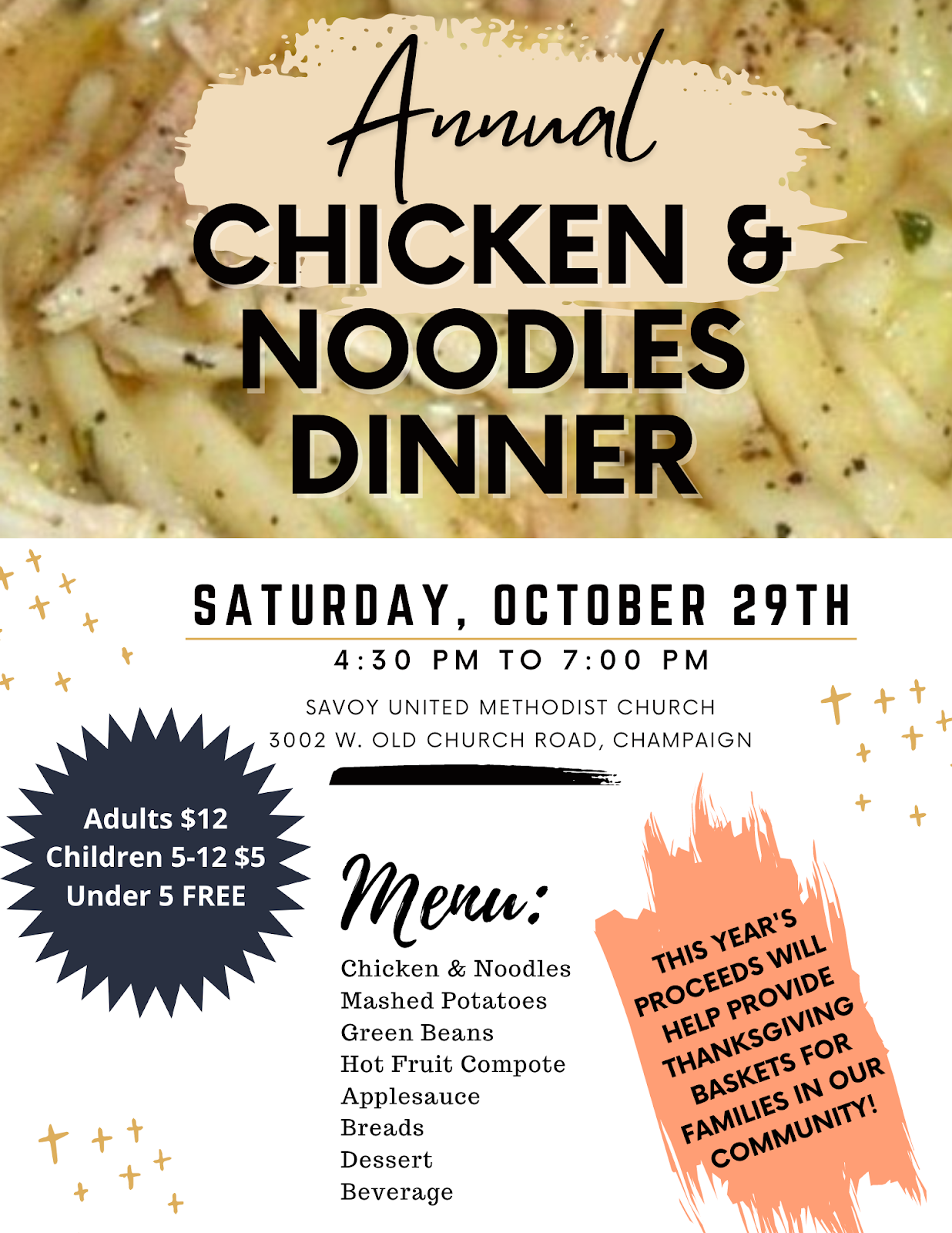
The dinner menu includes Chicken & Noodles, mashed potatoes, green beans, bread, dessert, and more. The cost is $12 per adult and $5 for kids between the ages of five and 12. Children under five years of age can eat free. The meal will be served at
"On average, we give out around 100 baskets or so each year. Last year was our largest in memory. We were able to feed 201 families," said Angela Hancock, who is co-chairing the Thanksgiving Basket committee at the church with her spouse. "It has grown and changed as the need and the vision have changed over the years."
Hancock said that prior to last year, it cost $45 to assemble each basket which contains a full meal for a family of four to six. The meal consists of a 14lb turkey, 5lbs of russet potatoes, milk, butter, eggs, dinner rolls, stuffing mix, gravy mix, canned vegetables, pumpkin pie, cool whip, cranberry sauce, a foil pan for baking, and recipe cards for first-time cooks.
"Inflation has hit all of us hard. Basket prices have jumped to $60 each, she explained. "This year, our goal is to feed 125 families. If we can do more, we will."
Every member of United Methodist contributes what they can to the program. From making donations and fundraising to distributing baskets, and all things in between, it is a complete effort by the congregation.
The Thanksgiving basket program is also a cooperative effort that receives support from local businesses with transportation trailers, forklift equipment, a refrigerated truck, and local grocery stores for bulk ordering.
"Some (members) can sponsor half a basket, others can do a full one. Others do multiple baskets. It's what we are able to afford at this time of year. God and fundraising efforts ensure the rest," Hancock said. "Funds play a major role in how many families we can feed."
A successful fundraiser on Saturday will ensure the church can help more area families enjoy this Thanksgiving holiday.
"We do this in His Name so that His people don't forget they are Seen," Hancock pointed out. "This is truly a community response to a need so many have. No one should have to be without at Thanksgiving time. And with God, no one ever will.
"God ensures that we hear about the needs of our community and our congregation steps up with donations and fundraising."
The dinner menu includes Chicken & Noodles, mashed potatoes, green beans, bread, dessert, and more. The cost is $12 per adult and $5 for kids between the ages of five and 12. Children under five years of age can eat free. The meal will be served at