Clash of the conference Titans; SJO outlasts Unity


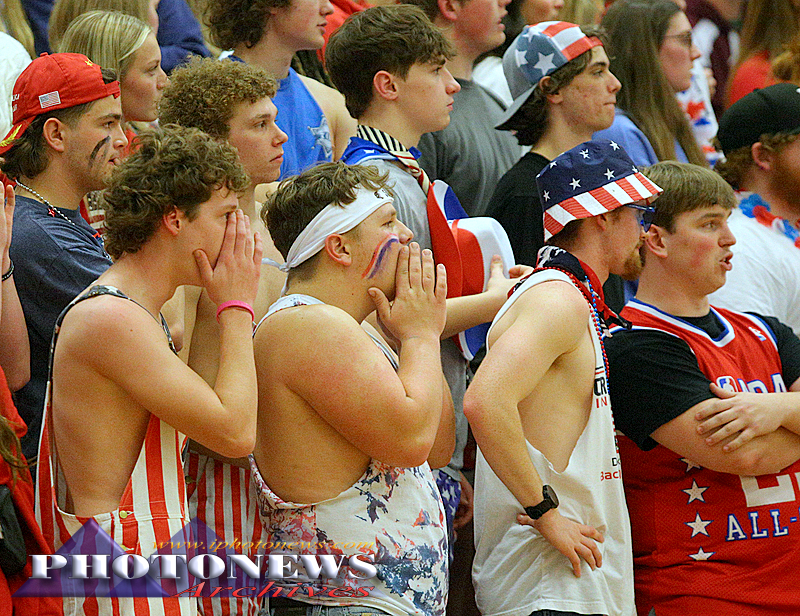
TOLONO - There weren't a lot of open spaces in the stands to plop down and watch the ensuing epic basketball game between visiting St. Joseph-Ogden and the host Unity at the Rocket Center on Friday. While it was a mild winter's evening outside, it was the heat and humidity of a Florida spring in the near-capacity-filled gym. The air was brewing with palatable excitement as the two teams with a combined record of 45-8, each enjoying a four-game win streak heading toward tipoff, warmed up.

Unity's Dane Eisenmenger tries to keep St. Joseph-Ogden's Luke Landrus from getting deep penetation into the paint during first quarter action of their Illini Prairie Conference game on Friday. See more photos below.

Photo: PhotoNews Media/Clark Brooks

Unity (23-3) snagged the opening tip and it wasn't long before fans were forced to the edge of their seats by the 5's, Unity's Henry Thomas and SJO's Logan Smith. The two seniors, who later hugged after St. Joseph-Ogden (23-6) prevailed in the 73-72 overtime win, put on an impressive show of basketball skill, tenacity, and mental toughness.

"This was a fun basketball game," said Unity head coach Matt Franks. "This is what high school basketball is all about. I thought it was a great atmosphere."

Smith, who finished the contest with a game-high 29 points had five assists and three rebounds, drew first blood on a layup to momentarily put St. Joseph-Ogden in the lead on the scoreboard.

St. Joseph-Ogden head coach Kiel Duval said players like Smith, with his mindset, are tough to beat.

"It is tough to knock him down. He is an absolute winner," he said. "He has a 'refuse to lose' mentality. When you've got that, you are tough to beat."

On the next two possessions, Thomas scored in the paint giving, and Dalton O'Neill added two more points on a reverse layup to give the Rockets a 6-2 lead.

"Henry has worked really, really hard to get his game to where he can have a night like this," Frank said. Thomas finished the contest with a team-high 27 points and was four-for-eight from the charity stripe. Two Fridays earlier, the senior scored his 1,000th career point against Prairie Central at the Rocket Center. "I think it was a perfect combination of teammates moving the ball well so Henry can do what he does."

The Spartans would even the score on two free throws from Luke Landus and a jumper from junior Coy Taylor, tying the game at six-all.

After buckets from Unity's Tyler Henry and Eric Miebach, Andrew Thomas drains a trey, putting the Rockets up 13-6 with 1:20 left in the quarter. Flustered, the Spartans called a timeout.

The Rockets continued to lead on the scoreboard until Smith knotted the game at 19-all. After converting a free throw, SJO takes a 20-19 lead.

Unity shotmaking went cold after Coleton Langendorf hit his free throw to tie the game again at 20-all. Taking advantage of the lull, the Spartans make an 11-point run, going up 31-20.

In control the rest of the first half through the first four minutes of the fourth quarter, SJO held a comfortable lead on their hosts until the last four minutes and 12 seconds of regulation time when Henry Thomas racked up eight points consecutive points, trimming his team's deficit from seven to two, 64-66.

"We got into foul trouble and had some bad matchups," Duval explained. "Their best player got looks at the basket. Once we got into foul trouble, we had trouble recovering from that. We kind of went away from doing some of the stuff we did to get good looks."

With 10.7 seconds left in the game, SJO's Tanner Jacob sinks the first of two free throws and misses the insurance basket. Unity gets the rebound and the ball down to Dane Eisenminger, who pumped a shot outside the arc in front of his team's bench. The trey falls with three seconds left in regulation time, sending the game into overtime at 67-all and the Rocket Center into an unabashed frenzy.

Smith was the only player from either team to hit a field goal in overtime, helping St. Joseph-Ogden tallied six points against Unity's five to end one of the most exciting basketball games in the St. Joe-Unity rivalry.

"Both teams played really hard," Franks said. "A game like this could have gone all night. It was great basketball."

A free throw away from a second overtime, Franks said his game plan would have been to stay poised and composed if they had to go another session.

"(We would) stay in the moment. It's all about the next possession, and we'd have to just focus on that," he said. "St. Joe is a great team, and it takes a great effort to beat them."

Duval was expecting a dogfight and had no illusions, counting unhatched chickens. Earlier in the season, SJO suffered two losses in the last-second heartbreakers. The first in a non-conference game at Beecher 55-53, and the second on a buzzer-beater in the Small School Division State Farm Holiday Classic championship game to El Paso-Gridley.

"There were two good teams battling back and forth. We knew they were going to throw another punch," he said. "They are at home. They always play better at home."

Also contributing to SJO's scoring effort was Luke Landrus, who finished with 13 points, and Coy Taylor, 3-for-3 at the line, with 12 points. Tanner Siems had eight points, and Tanner Jacob drained a pair of treys and a free throw to finish with seven points.

Andrew Thomas, Henry's twin, finished with 13 points, and Dalton O'Neill, who went five-for-six on free throws, contributed 12 points. Eric Meibach (9), Dane Eisenmenger (5), Jay Saunders (3), and Tyler Henry (2) contributed in the Rockets' effort. Coleton Langendorf hit a solo free throw for one point.

"It was like a sectional championship game," Duval said, talking about the atmosphere. "That was huge. I am proud that our guys found a way to win."


Game Gallery


Editorial |
Going for broke


Commentary |
This Black History Month, fight for the freedom to learn


by Svante Myrick


A little over a year ago, the College Board unveiled its long-awaited draft AP African American Studies curriculum. What happened next was sad — and all too predictable.

Florida officials, led by Gov. Ron DeSantis, howled. They claimed the course “lacks educational value” and violated state laws against teaching about race and racism. The College Board initially caved to Florida’s demands and said the course would be heavily redacted, then said it wouldn’t.

At the end of 2023, it released the final version of the course, and it’s…better. But it’s still missing some important concepts. The new course omits any discussion of “structural racism” and makes studying the Black Lives Matter movement — modern Black history by any measure — optional.

That pretty much sums up the state of the fight against censorship and book-banning in this Black History Month: better, but still problematic.

On the plus side, the last few months have brought some very good news.

School board candidates endorsed by the pro-censorship group Moms for Liberty went down to resounding defeats last fall. After Illinois became the first state to prohibit book bans, several states — including Colorado, Kansas, Massachusetts, New Jersey, New Mexico, Washington, and Virginia — introduced their own anti-ban bills.

In December, two Black lawmakers, Reps. Ayanna Pressley (D-MA) and Maxwell Frost (D-FL), introduced bills in Congress aimed at fighting book bans. And a federal judge ruled that parts of an Iowa book ban were unenforceable.

But the censorship movement isn’t going away.

Moms for Liberty plans to start its own charter school in South Carolina. In other words, if you won’t let them ban books in your school, they’ll just start their own school. With your taxpayer money.

Meanwhile, librarians nationwide are being targeted by threats and harassment. And the propaganda outfit PragerU continues to pump out the offensive, woefully inaccurate junk it calls “edutainment” for public schools that will buy it.

So there’s still work to do.

Fortunately, the public is overwhelmingly on the right side of this issue. Poll after poll shows that Americans don’t support censorship and book bans in schools. Those of us who want children to have the freedom to learn are the majority.

We understand that kids are better prepared for life — and our country is better prepared to compete globally — when education is historically accurate and reflective of the diversity of our culture. We understand that book banning is un-American and censorship is a tool of dictators.

This majority needs to mobilize and be heard at the ballot box. The defeat of pro-censorship school board candidates in 2023 was a great start. Now we have to take that momentum into the local, state, and national elections this fall.

In the meantime, we also know that public pressure works. A public outcry got the College Board to change its plans for the African American Studies course. And when publisher Scholastic said it would segregate books about the Black and LGBTQ communities at its school book fairs, the public was outraged — and Scholastic reversed course.

Together, we have the power to stop the censors who want to whitewash our history and deprive kids of facts and stories that help them to understand our world. That applies to the Black experience in America, but also the experiences of LGBTQ people, Indigenous peoples, people of diverse faiths, immigrants, people with disabilities, and more.

Civil rights activists have pushed for decades for book publishers and educators to acknowledge and teach our full history, and to awaken our consciousness as a nation. We refuse to go backwards.

Black History Month is a great time for us to commit to using the power that we have to protect the freedom to learn. Our kids, and our country, will be better for it.


About the author:
Svante Myrick serves as President and CEO of People For the American Way. Myrick garnered national media attention as the youngest-ever mayor of Ithaca, New York. This op-ed was distributed by OtherWords.org.


Smith puts on a superb show slipping Spartans past Unity


Logan Smith
Braxton Waller (left) congratulates St. Joseph-Ogden's Logan Smith after the basketball team's 73-72 overtime win at Unity (23-3) Friday evening at the Rocket Center. Smith had a career night, dropping a game-high 29 points on the Rockets' home court. The senior sunk the clutch, game-winning free throw in overtime to give SJO a 73-70 advantage with eight seconds on the clock. The Spartans improve to 23-6 and have nearly clinched the conference title (8-0) with one game to go in the regular season. Smith and the Spartans take their show on the road Tuesday to face Paxton-Buckley-Loda. More photos and game recap coming soon.

PhotoNews Media/Clark Brooks


Leaving it on the floor, Rockets fall in OT


TOLONO - Unity's Henry Thomas drives to the paint in front of St. Joseph-Ogden's Luke Landrus. Thomas, who helped his team rally back from a 13-point third quarter deficit and into overtime, scored 27 points in their Illini Prairie home game against the Spartans. Exhausted, the Rockets (23-3) left it all out on the floor in front of nearly a packed house, suffering their third loss of the season by one 73-72. More photos and game recap coming soon.
Photo: PhotoNews Media/Clark Brooks


Packed house expected at the Rocket Center


TOLONO - Around 7 p.m. tonight, the event local basketball fans have been waiting for has finally arrived. Unity will put their 23-2 record on the line against the 22-6 Spartans of St. Joseph-Ogden at the Rocket Center.

SJO, undefeated in conference play at 7-0, has defeated their last four opponents by 12 or more points. Earlier this week, the Spartans crushed Rantoul at home by 33 points. Tanner Jacob, who was 2-for-2 from the free-throw line, led the team with 15 points in the senior night win.

Henry Thomas shoots a free throw during Unity's home game against Prairie Central. The senior scored his 1,000th career point earlier in the contest.

Photo: UnityPhotos/Jamie Price

Coy Taylor, Tanner Siems, and Luke Landrus also finished in double figures with 14, 13, and 10 points, respectively.

Unity is also on a four-game win streak, posting wins over Newton, Auburn, IVC, and Central Catholic in contests since January 31.

Two weeks ago tonight, Rockets' Henry Thomas reached a prep career milestone while putting up 21 points on Prairie Central. The senior scored his 1,000th point, helping the team avoid a possible overtime decision against the Hawks in a 60-56 win.


Letter to the Editor |
Will Illinois lawmakers heed Oregon's failed experiment


Dear Editor,

In 2020, Oregon voters decriminalized possession of small amounts of almost every hard drug. Progressives campaigned in support of this ballot measure, insisting that their state should help treat addiction rather than punish it. The measure passed with 58 percent support.

Now, Oregon's governor has declared a drug emergency, as overdose deaths have been climbing year after year and Democratic lawmakers who first pushed to decriminalize drugs are admitting it isn't working.

Even The New York Times acknowledges that it is out of control, saying in a recent article, “Portland used to be known as one of the most desirable places to live in the United States. But in recent years, the city has been struggling with widespread fentanyl use on its streets, which has led to an increase in homeless encampments and crime.”

Writing in Newsweek, former Presidential drug policy advisor Kevin Sabet says that even while the declaration of a "state of emergency is a step in the right direction, more must be done to undo the harm..."

Will Illinois lawmakers, including self-styled "libertarians," heed this experiment gone awry? Public policies have consequences. Decriminalization leads to more overdose deaths, more crime and more public drug use.


David E. Smith, Executive Director
Illinois Family Institute


Commentary |
Appeals court rules against Trump, deciding presidents are not immune from prosecution


by Claire Wofford
Associate Professor of Political Science, College of Charleston


In a 57-page opinion issued on Feb. 6, 2024, a federal appeals court ruled against former President Donald Trump, deciding that presidents are not immune from criminal prosecution for actions they took while in office.

The decision allows the federal prosecution of Trump for attempting to undermine the 2020 election to continue.

Viewpoints
A three-judge panel of the U.S. Court of Appeals for the District of Columbia Circuit – two appointed by Democratic presidents and one by a Republican – affirmed the Dec. 1, 2023, ruling of District Court Judge Tonya Chutkan, in which she said that a former president does not enjoy complete immunity from criminal prosecution for actions taken while in office.

The Hill reported that Trump spokesman Steven Cheung responded to the appeals court ruling by saying, “President Trump respectfully disagrees with the DC Circuit’s decision and will appeal it in order to safeguard the Presidency and the Constitution.” The decision, Cheung said, “threatens the bedrock of our Republic.”

The appeals court panel rejected Trump’s argument that the structure of U.S. government and the demands of the presidency necessitated immunity, instead stating that his claims of “unbounded authority to commit crimes” would “collapse our system of separated powers.” In their words, “President Trump has become citizen Trump,” and therefore had only the defenses available to any criminal defendant, not a special immunity privilege unavailable to anyone else.

As a scholar of judicial behavior and American politics, I have been closely watching this case. The court’s decision, particularly if the Supreme Court allows it to stand, is likely to have ramifications across the U.S. legal and political systems for decades.

‘Divine right of kings’

Trump is the subject of multiple civil and criminal cases in both state and federal courts. He is currently appealing several of them, including one relating to his appearance on the Colorado ballot, which the Supreme Court has already agreed to hear.

In mid-December 2023, the federal government asked the Supreme Court to weigh in on the immunity dispute as well, but the court declined to do so, at least until the appeal was heard by the U.S. Court of Appeals for the District of Columbia Circuit

This particular case involves the prosecution of Trump by special counsel Jack Smith. On Aug. 1, 2023, Smith indicted Trump on four counts of violating federal law for his conduct relating to the 2020 election, including conspiracy to defraud the United States, conspiracy to obstruct an official proceeding, obstruction of and attempt to obstruct an official proceeding and conspiracy against rights. The proceeding in the appeals court was not about whether Trump committed these crimes but whether he could be prosecuted for them at all.

Trump’s argument centered on a claim of presidential immunity – the notion that a president cannot be subjected to legal action for official conduct or actions taken as part of the job. While there is no explicit language in the U.S. Constitution about such immunity, the Supreme Court had previously ruled in Nixon v. Fitzgerald that presidents can be protected from civil lawsuits for their “official acts.”

The Nixon decision did not control the outcome here, however, because that case involved a civil lawsuit rather than a criminal prosecution. As highlighted during the oral argument in Trump’s appeal, that distinction – of whether it’s a civil or criminal case – makes a world of difference.

Protecting the president from the hassles of civil litigation is one thing; permitting the president, charged in Article 2 of the Constitution with faithful execution of the laws, to be able to break those same laws with impunity is quite another.

That sort of upside-down world is precisely what led District Court Judge Chutkan to issue her sweeping ruling on Dec. 1, 2023, that presidents are not immune from prosecution for crimes committed while in office. As she put it, Trump did not have the “divine right of kings to evade criminal accountability.” The court today agreed with that sentiment.

High stakes

The oral argument before the appeals court on Jan. 9, 2024, was similarly dramatic.

The three judges spent over an hour rigorously questioning both sides, and the language was often sweeping.

Trump’s lawyer spoke of a president’s need to take “bold and fearless” executive action, to not have to constantly “look over their shoulder” for fear of prosecution and of the “republic shattering” consequences of ruling against the former president. Judge Florence Y. Pan raised striking hypotheticals about presidents assassinating political opponents or selling national security secrets to foreign governments. The lawyer for the federal government noted the “frightening future” if presidents were free to violate the law while in office.

The court’s opinion addressed Trump’s argument that future presidents would be unable to take decisive action for fear of prosecution. The judges ruled that the risk of “chilling … Presidential action appears to be low” and was outweighed by the public’s interest in accountability.

The appeals court judges included a passage from a Supreme Court opinion in their decision:

“No man in this country is so high that he is above the law. No officer of the law may set that law at defiance with impunity. All the officers of the government, from the highest to the lowest, are creatures of the law and are bound to obey it.”

That principle, the appeals court panel wrote, “applies, of course, to a President.”

The court’s Feb. 6, 2024, decision will have a substantial impact, at least until any final ruling is issued by the Supreme Court.

Trump can be criminally prosecuted for the actions he took to overturn the 2020 election. Whether the case makes it to trial or results in a conviction, what happens to all the other pending cases involving Trump, and whether the former president is returned to the White House, are unanswered questions so far.

The Supreme Court will surely be asked to provide some of those answers.


The Conversation Claire Wofford, Associate Professor of Political Science, College of Charleston This article is republished from The Conversation under a Creative Commons license. Read the original article.

Commentary |
Could tackle football become a thing of the past? Flag football gaining popularity


by Josh Woods
Professor of Sociology, West Virginia University


One hundred years into the future, what if millions of people gathered every February, not to watch the Super Bowl, but to instead watch the annual world flag football championship?

Once a casual activity played at family reunions, the competitive sport of flag football is “soaring,” “exploding” and “skyrocketing in popularity nationwide,” according to mainstream news outlets.

The number of kids playing flag football has risen dramatically over the past nine years.
Photo: Joshua Choate/Pixabay

There’s some data behind the breathless headlines: According to the NFL’s official flag football program, since 2015 the number of kids ages 6 to 12 who play flag football has risen by 38%, to more than 1.5 million.

In my recent book, “Emerging Sports as Social Movements,” I explore nontraditional sports like flag football and disc golf. One of my key findings is that splashy headlines about trendy sports rarely capture a sport’s true reach and staying power.

For every sport like pickleball that gains widespread, sustained popularity, there are several – adventure racing, paintball and wakeboarding – that remain firmly ensconced in their niche.

In the case of flag football, there are a handful of recent trends that truly do point to a promising future. But there are also some red flags that could end up hampering its growth.

A fun, fast, safer alternative

Though its rules are similar to tackle football, flag football is currently gaining attention for what makes it different.

It’s considered a no-contact sport. A “tackle” involves snatching one of two flags that hang from the hips of the ball carrier. While players face injury risks, they sustain far fewer head impacts than athletes who play tackle football.

With the public’s concerns about brain injuries on the rise, many parents are opting for flag football instead of tackle for their kids.

Obscurity is a powerful barrier to emerging sports. But getting noticed may not be a problem for flag football.

The International Olympic Committee announced in October 2023 that flag football would be headed to the Summer Games in Los Angeles in 2028. It’s not clear yet if active NFL players can compete, but if they are eligible – and if the U.S. assembles a “Dream Team” like the Olympic men’s basketball team of 1992 that included superstars Michael Jordan, Larry Bird and Magic Johnson – flag football could get on the radar of millions of casual sports fans in 2028.

The Olympic version of flag football is fast-paced

Games are shorter than a typical game of tackle football. Five players compete on 50-yard fields with 10-yard end zones for two 20-minute halves. This format made its first big appearance in the 2022 World Games in Birmingham, Alabama, where the U.S. men won gold and the women took home silver.

The NFL cultivates the grassroots

Although it may come as a surprise, the NFL is embracing flag football and taking its growth seriously.

In 2021, the NFL and Nike committed US$5 million in equipment to support high school flag football teams across the nation. The NFL’s official flag football program operates more than 1,600 local leagues and receives sponsorships from top brands like Visa, Gatorade and Subway.

Most NFL teams are currently supporting the grassroots of flag football with summer camps, clinics and regional tournaments.

During last year’s Super Bowl, an estimated 115 million viewers watched a flag football TV commercial featuring Mexican quarterback Diana Flores bobbing and spinning to evade NFL players and celebrities as they attempted to take her flag.

On Feb. 4, 2024, the Pro Bowl – the NFL’s annual all-star game – sidelined tackle football for the second year in a row. In its place was a 7-on-7 flag football game that aired on ESPN and ABC and streamed on ESPN+.

Prior to that game, on Feb. 2-3, the league also hosted the International NFL Flag Championships as part of the Pro Bowl Games, featuring young athletes from 12 countries.

By the numbers

Flag football may be having a moment, but the question remains: Is the sport actually experiencing a meaningful surge in participation that could extend into the future?

According to figures collected annually by the National Federation of High Schools, 21,980 students played high school flag football in 2023. To put this number in context, however, tackle football attracted 47 times more students – roughly 1 million players – the same year. Track and field, basketball and soccer have roughly 1 million participants apiece.

Interest in flag football seems to be concentrated in a few regions, with roughly 80% of high school players living in just three states: Florida, Georgia and New York.

Though high school participation in flag football has increased steadily since 2007, almost all the growth comes from the girls’ side.

A nationwide sports participation survey finds that the number of casual players of flag football is up, but core participation is down. The study defines “casual players” as those who play fewer than 50 times per year, whereas “core players” participate 50 or more times each year.

The share of Americans who play casually increased by 41% between 2016 and 2022. But core participation declined by 13% during this period.

For sustainable growth, nontraditional sports need to generate excitement among both core and casual players. Top-down investments and marketing strategies may attract new players, but grassroots organizing keeps them coming back.

Take pickleball. In recent years, the sport has generated plenty of cultural clout, with high-profile athletes like LeBron James investing in the professional circuit, and celebrity pickleball players making headlines. There has also been tremendous growth in pickleball’s social and physical infrastructure. For these reasons, both casual and core participation in pickleball more than doubled between 2016 and 2022.

Red sport, blue sport

In the end, the future of flag football may hinge on the public debate over tackle football’s safety. Over the past decade, several studies have found a link between repeated head impacts and the risk for serious brain injuries, including chronic traumatic encephalopathy, or CTE.

Photo: Ty Swartz/Pixabay

Yet recent efforts to make tackle football safer for young athletes have been met with fierce resistance from families, fans and organizers. In many regions of the U.S., tackle football is deeply ingrained in the culture, leading to strong opposition to any changes.

New rules to protect NFL players have seeped into mainstream politics. For instance, in 2019, former President Donald Trump dubbed the NFL’s concussion protocol “soft” and said that safety measures were “ruining the game.”

Meanwhile, Democratic state lawmakers in New York, Illinois and California have introduced bills to ban tackle football for kids under 12, often citing flag football as a suitable alternative. None of these bills, however, have passed.

Some research shows that Democrats are more likely to trust concussion science than Republicans. Democrats also pay more attention to news about concussions than Republicans.

As beliefs about the dangers of tackle football become polarized, the perceived benefits of flag football will likely follow suit. As I showed in a recent study of sport popularity in 207 areas of the U.S., flag football is more popular in regions that tend to vote Democratic, with tackle football more popular in Republican areas.

So in addition to going after the resources needed for sustainable growth – investment, organization, visibility, legitimacy – flag football’s advocates will also need to navigate a nation divided by politics.


The Conversation

Josh Woods, Professor of Sociology, West Virginia University This article is republished from The Conversation under a Creative Commons license. Read the original article.


Loading latest story ...


| Most recent articles

Loading recent stories ...


Illustrious - Showcases and the stories behind Illinois’ most iconic high school gyms

CHICAGO - On a quiet Saturday afternoon in January 2012, at the Oak Park-River Forest field house, a simple thought refused to leave Vincent Johnson alone.

Covering a girls basketball game for the Oak Leaves, Johnson found himself looking beyond the box score and into the bones of the building itself. The space was overwhelming in the best way. Big. Empty. Striking. The field house - massive, architectural, overwhelming in character - was alive with echoes. The gym itself demanded his attention.


Some really cool hosting hacks for your holiday party

Entertaining friends and loved ones during the holidays offers an opportunity to slow down from the hustle and bustle of the holiday season and make lasting memories.

The key is getting ahead of hosting duties so you can be present with family and friends.


Spend less money, entertain more this holiday season

There is nothing like gathering with family and friends sharing the ups and downs of the past year and plans for the upcoming one.

The holiday season brings an abundance of feelings that ...


| Home Improvement

Loading recent stories ...


More Sentinel Stories