Learning from the voices of war: Honoring the 80th anniversary of the final major battle of WWII


Photo courtesy of Library of Congress Veterans History Project

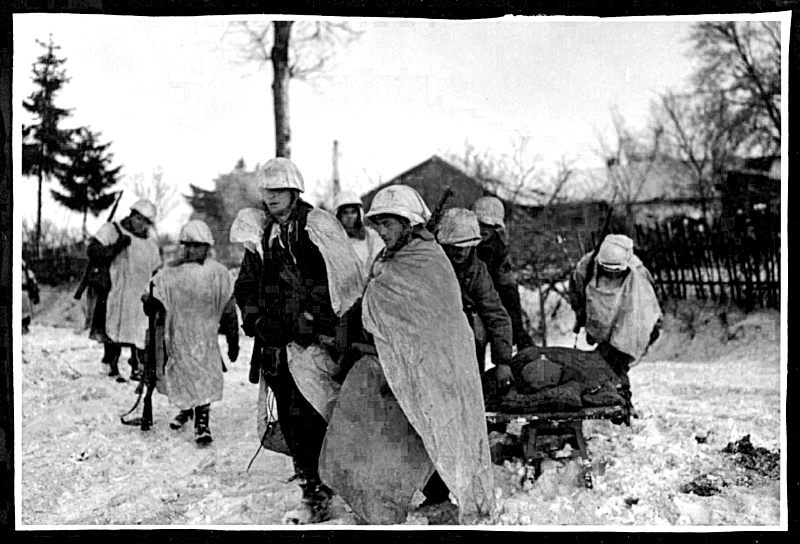
American troops pull back with wounded during World War II's Ardennes Offensive in December 1944.

Family Features- The Ardennes Offensive, commonly known as the "Battle of the Bulge", stands as the single bloodiest battle fought by the United States during World War II. Waged in the bitter cold of mid-December 1944, it took the Allies a month to secure victory. The cost was staggering: nearly 20,000 Americans were killed in action, close to 50,000 wounded and another 20,000 captured.

In honor of the 80th anniversary of this pivotal battle, the Library of Congress Veterans History Project has launched an online exhibit to commemorate the milestone. While the battle itself is etched in the annals of history, the personal stories from those who endured it remain one of the most powerful testaments to its impact.

The online exhibit, "Serving Our Voices," features accounts from 12 Battle of the Bulge survivors, part of the thousands of narratives preserved by the project. These stories ensure future generations can gain deeper understanding of veterans' service and sacrifice.

One such story includes Eliot Annable, a 20-year-old radio operator serving with the Army's 106th Infantry Division. Just days after arriving at the western front, Annable found himself under German artillery barrages on. Dec. 16, 1944. He recalled the assault in his oral history, describing the intensity as "almost enough to knock you on the floor."

The following five days became the most harrowing days of Annable's military service. While on a communications mission, he became stranded behind enemy lines and spent nearly a week evading the enemy in the Ardennes Forest without food, shelter or appropriate winter clothing. After traveling more than 30 miles, he eventually safely rejoined the remnants of his unit.

Photo courtesy of Library of Congress Veterans History Project

Back home, Annable's parents were gripped by uncertainty. On Dec. 31, 1944, his father wrote a letter expressing the family's anguish and love for their son, regardless of what happened. The moving letter, coupled with Annable's oral history, provides an intimate view into one soldier's Battle of the Bulge experience.

Another featured veteran in the exhibit, Guy Martin Stephens, also served with the 106th Infantry Division. Unlike Annable, Stephens was captured by the Germans during battle. In his oral history, he recounted the surreal feeling of combat, the relentless hunger he endured as a prisoner of war and the lingering effects of his time in captivity.

"It's hard," Stephens said. "It's something you can't ever ... your mind is just like a video, or camcorder, I guess. You put it in there. You get busy and get married. You get home, and you get an education, and get a job, and raise your family and everything like that. You can kind of gloss it over or try to push it back, but it's always there, you know?"

Veterans who served during the 20th or 21st centuries are invited to establish a collection, including interviews (video or audio), letters and original photographs, even if they did not see combat. Families can also submit collections posthumously to honor their loved ones. To explore more veterans' stories and learn how you can contribute to the program, visit loc.gov/vets.


How to discuss getting vaccinated with family and friends


Focus on the facts. For certain people, the risk of serious respiratory illness remains high. These include adults ages 65 and older, residents of long-term care facilities, pregnant people, people with certain health conditions and those living in rural areas.

Family Features - During the fall and winter months, respiratory infections such as flu, COVID-19 and RSV can surge. People who are vaccinated lower their risk of getting seriously ill and needing medical care if they get infected.

About 70% of adults in the United States said they probably or definitely will get a flu shot, and more than 50% said they probably or definitely will get an updated COVID-19 vaccine. While many people are ready to get this season's vaccines, others might still have questions.


Photos courtesy USDHHS

"It is normal for people to have questions about vaccines," said Peter Marks, MD, PhD, director of the U.S. Food and Drug Administration's Center for Biologics Evaluation and Research, which oversees and reviews vaccine clinical trials. "It's important for everyone to know that all vaccines go through extensive testing before they are approved and that following approval, they are carefully monitored to identify any safety concerns so that they can be addressed quickly. Hundreds of thousands of volunteers have taken part in respiratory vaccine trials. The results tell us that these vaccines are safe and effective in preventing severe disease caused by flu, COVID-19 and RSV."

Here are some ways to talk about the importance of this season's vaccines with a family member or friend who is unsure about getting vaccinated.


Hear them out. When talking about vaccination, it's important to make others feel heard. There are many reasons why people may have questions and concerns about vaccines or even the health care system in general. Listen to their thinking and try not to judge. They want to know their thoughts and feelings matter.

Focus on the facts. Instead of calling out vaccine myths, focus on vaccine truths. Concentrating on myths can cause them to become the topic of your conversation. Instead, speak about the benefits of vaccines. For instance, you can mention vaccines cut your risk of being hospitalized for flu or COVID-19 by about half.

Ask if they need help getting vaccinated. Sometimes, people just need some help to find, schedule and get a vaccination. You can help them find a vaccine location at Vaccines.gov. They may also need help finding child care or figuring out whether they can take time off from work. Offering a ride or accompanying them can also be helpful, especially if the closest vaccination site is far away. If English is not their primary language, offer to help them schedule the appointment and arrange for a medical translator if needed. When it's easier to get vaccinated, people are more likely to take this important step to help protect their health.

Having open, honest and supportive conversations about vaccines with family members and friends can make all the difference. For more information, visit cdc.gov/RiskLessDoMore or talk to your doctor.

Flu, COVID-19 and RSV Vaccines Help People Risk Less Severe Illness and Do More of What They Enjoy

This season's vaccines are now available. Everyone 6 months and older should get an updated flu and COVID-19 vaccine. Everyone ages 75 and older, or 60 and older with certain health conditions such as such as heart disease, lung disease, obesity or diabetes, should get an RSV vaccine if they have not been vaccinated for RSV before.

For certain people, the risk of serious respiratory illness remains high. These include adults ages 65 and older, residents of long-term care facilities, pregnant people, people with certain health conditions and those living in rural areas. People in some racial and ethnic groups, including people who are Black or Hispanic, are also at higher risk. People who are not up to date on flu, COVID-19 and RSV vaccines can reduce their risk by getting their 2024-25 vaccines as soon as they can.


SJO hosts basketball shootout on Saturday


St. Joseph-Ogden's Addie Brooks looks for an open teammate to pass the ball at last December's Country Financial Shootout. Brooks and the Spartans defeated ALAH, 49-39. Shootout hosts SJO (3-3) will play Salt Fork (7-0) at 4 PM.

Photo: OurSentinel.com
ST. JOSEPH - Now that the boys' Toyota of Danville Classic is in the books, St. Joseph-Ogden will host an eight-team girls' shootout this Saturday. Opening the four-game event, the Paris Tigers will take on the Cardinals of Pleasant Plains at 1 PM in the high school's main gym for The Country Financial JV/VARSITY Girls Basketball Shootout.

Admission is $8 for adults and $5 for students with valid Student IDs.

The Spartans will face Salt Fork at 4 PM, after the 2:30 PM Fieldcrest and Cissna Park matchup.

Unity (6-3) will play the following nightcap at 6 PM against the Lady Warriors of Watseka.

The Country Financial Girls Basketball Shootout Schedule
Varsity (SJO HS Main Gym)
Varsity: 8 Minute Quarters – 10 Minute Halftimes & 12-15 Minute Warm-Ups

1:00 PM:
(NE Locker Room) Pleasant Plains vs. Paris (SW Locker Room)

2:30 PM:
(NW Locker Room) Fieldcrest vs. Cissna Park (SE Locker Room)

4:00 PM:
(NE Locker Room) Salt Fork vs. St. Joseph-Ogden (SW Locker Room)

5:30 PM:
(NW Locker Room) Watseka vs. Unity (SE Locker Room)


Junior Varsity (SJO PRACTICE GYM)
JV (8 Minute Quarters – 8 Minute Halftimes & 10-12 Minute Warm-Ups) Games MAY Start Up to 15 Minutes Early

11:00 AM:
(NE Locker Room) Pleasant Plains vs. Paris (SW Locker Room)

12:30 PM:
(NW Locker Room) St. Joseph-Ogden vs. Cissna Park (SE Locker Room)

2:00 PM:
(NE Locker Room) Salt Fork vs. St. Joseph-Ogden (SW Locker Room)

3:30 PM:
(NW Locker Room) Watseka vs. Unity (SE Locker Room)


Spartans wins Saturday home meet over Tigers


ST. JOSEPH - Spartan Thomas Ware tries to escape a takedown attempt by his opponent from Urbana Saturday morning. Ware secured a third-period pin to help St. Joseph-Ogden defeat the visiting Tigers, 59-34.
Photo: Sentinel/Clark Brooks


SJO advances to basketball tournament title game, Spartans to face the Fightin' Irish of Bishop Mac


ST. JOSEPH - Spartans Coy Taylor and Parker Fitch dive for a loose ball to keep away from Charleston's Mason Redfern during the last game of pool play at the Toyota of Danville Classic Basketball Tournament. St. Joseph-Ogden advanced to today's championship game against Bishop McNamara at 5:30 PM after battling to a 54-40 victory Friday night. Charleston will face Paxton-Buckley-Loda at 4 PM in the third place game.
Photo: Sentinel/Clark Brooks


ALAH defeats Watseka 49-44 at Toyota of Danville Classic


ST. JOSEPH - Arthur-Lovington-Atwood-Hammond's Will Hilligoss takes the ball down the court during the last ten seconds of his team Toyota of Danville game against Watseka. The Knights advance to Saturday's fifth-place game after pulling out a thrilling 49-44 victory over the Warriors. Hilligoss finished the game with six points behind teammate Kendall Schrock's 18 points and 12 points from Nate Hale. ALAH take on Cissna Park for the fifth-place trophy. In the game scheduled before their 2:30 PM contest, Watseka sqaures off against Oakwood on championship day at the annual early season basketball tournament.
Photo: Sentinel/Clark Brooks


We are looking for awesome photos
Did you take a great photograph at any of these games? We would love to share it with our readers.

Sign up for the Sentinel

Prep Hoops |
Thursday Basketball Scores


Girls' Basketball

St. Joseph-Ogden 57 - Danville 39
Kayla Osterbur dropped a team-high 14 points in the Spartans' home game against the Vikings. Addie Brooks was good for another 12 to pull out the W for the team's third win of the season. Danville's Jada Bell led all scorers with 18 points. She converted on eight of her 10 free throws attempts.


Unity 33 - Arthur-Lovington/Atwood-Hammond 27
With the Knights shooting just 48 shots, sophomore Morgan Casteel shot 29% from the field to lead her team with nine points on the road against the Rockets. Unity host the Urbana Tigers on Monday for their annual non-conference rivalry game.
Glenwood 59 - Centennial 15
The Chargers drop to 1-5 after the road loss. Centennial looks ahead to Tuesday's home game against Peoria Manual to halt a three-game skid.
Urbana 30 - Urbana University 26
The Tigers are 2-1 after defeating the Illineks of U-High. Sophomore Lai'yonna Harper led Urbana with 10 points. Junior Madison Shade added seven to the cause. The Tigers, who finished 1-20 in the previous season, look for win number three at Unity on Monday.

Chizara Onyemele paced the Uni with ten points.


Boys' Basketball

Central 69 - Richwoods 65
The Maroons (4-2) notched their first conference win with four players reaching double figures. Chris Bush led the scoring output with 24 points. Luke Swanson delivered an 18-point performance while Cayden Love chipped in 12 points and Aidyn Beck added another 11. Swanson finished with seven boards and Trey Cole grabbed five more against the Knights (4-1). Central returns to action next Friday in another Big Twelve contest with Normal Community coming to town.


Attention Coaches: Help us keep area basketball, wrestling, and competitive dance fans informed! Email us your team's game and match results for the Prep Sports Notebook. Please send us a clear photo of the scorebook or link to game results at sports@oursentinel.com.

We are looking for great photos
Did you take a great photograph at any of these games? We would love to share it with our readers.

Sign up for the Sentinel

Few states are tracking dairy farmer worker health protections amid current Bird Flu outbreak


Records from 15 states with confirmed cases of bird flu in dairy cattle in the USA. Nearly 700 dairy cattle have been found infected.
Photo: Kylee Alons/Unsplash

by John McCracken
Investigate Midwest

In May, the Centers for Disease Control recommended that state public health departments, veterinarians and epidemiologists provide personal protective equipment, or PPE, for workers in direct contact with animals and their fluids, such as raw milk, that could be exposed to bird flu.

As of early December, almost 60 people have been infected with the virus, with the majority of cases stemming from human contact with dairy cattle. Nearly 700 dairy cattle herds have been infected.

The most effective way to protect workers is with face shields, latex gloves and respirators, the CDC advised.

However, records from 15 states with confirmed cases of bird flu in dairy cattle reveal inconsistent responses by agencies when it comes to providing farmworkers with personal protective equipment. Most state health agencies, which are often responsible for the human impacts of communicable diseases, have left PPE distribution to local county health officials.

The documents, which Investigate Midwest obtained through multiple public records requests, found:

  • At least a third of state health departments in states with confirmed dairy cattle outbreaks do not track the distribution of PPE.
  • Ohio, Wyoming and New Mexico, which have had active bird flu cases in dairy cattle, have either not tracked requests for farmworker PPE or are currently not accepting requests.
  • Only one dairy farm in Wisconsin, a major dairy state that has not had a confirmed cattle outbreak, has requested PPE from the state’s health department.
  • Minnesota has had few cases of bird flu in dairy cattle, but more than 200 agriculture businesses have received PPE from the state.
  • Michigan and North Carolina, which are also major dairy-producing states, have provided PPE to less than a dozen farms.

“It looks like a failure in how we’re communicating on the public health side to producers,” said Bethany Alcauter, director of research and public health for the National Center for Farmworker Health, a Texas-based nonprofit that provides resources and training to farmworkers and advocacy groups across the country.

Alcauter said farm operators and processors don’t have the same knowledge and outlook as public health officials because sick workers and animals are often part of the job.

“It’s not to say that they’re not getting sick, but because it’s maybe not that different from what they experience normally, it’s not going to change their perception of the risk just because it’s a different pathogen,” she said.
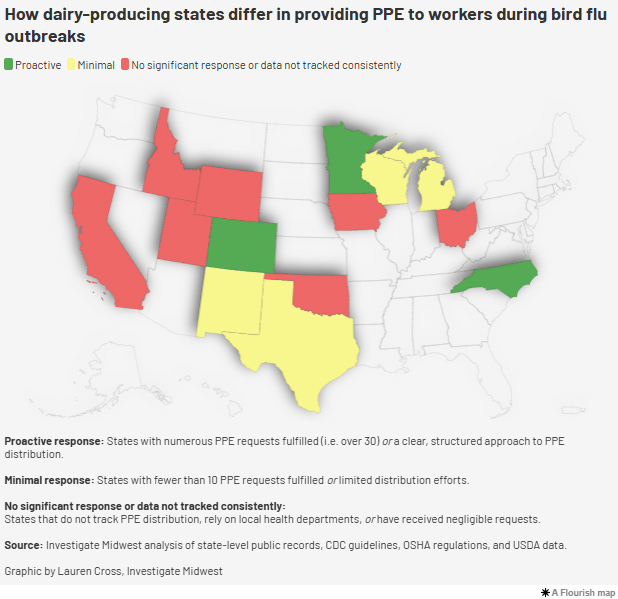

How dairy-producing states differ in providing PPE to workers during bird flu outbreaks

When dairy workers are milking cows, raw milk can come into contact with their hands, faces and bodies, increasing the risk of infection. The CDC advises that dairy workers wear PPE, including gloves, rubber overalls and face shields, to minimize the spread of the virus.

The Occupational Safety and Health Administration, OSHA, states that employers of workplaces where exposure to bird flu viruses could occur are responsible for providing PPE to workers and keeping records on infected animals and employees.

However, OSHA cannot enforce its standards on farms with less than 11 employees, an exemption that has harmed dairy workers in the past when dairy worker deaths and injuries went unreported. This makes the enforcement and responsibility of safety measures hard to pin down, Alcauter said.

“Workers are on their own in terms of actually enforcing anything,” she said.

Michigan and Colorado Workers Aren’t Using or Getting PPE

In a recent CDC study, the agency said that the prevention of human infections is critical to mitigating changes in the bird flu virus that could lead to a pandemic.

Employers can best reduce the risk of infection by providing and educating workers on the use of PPE, as well as monitoring and testing animals and workers for the virus, the study said.

While PPE is a needed tool to prevent the spread, the practical application can be hard for workers who are working long hours and completing repetitive motion tasks in tight corners and hot environments.

Every worker who contracted the virus has been tasked with cleaning and working in milking parlors, according to the study.

After surveying the predominantly Spanish-speaking workers at Michigan and Colorado dairies, the agency found that none of the workers who were infected with the virus reported using PPE. In fact, the use of PPE was low among all workers.

“This investigation identified low PPE adherence among dairy workers, which has been an ongoing challenge in hot, tight spaces where visibility around large animals is important and the use of eye protection can be challenging,” the study states.

Records obtained by Investigate Midwest show inconsistent PPE distribution processes in both Michigan and Colorado, where dairy industries have been wrestling with the virus since early this year.

From January 2023 to late September 2024, records show only 11 dairy farms requested PPE for farmworkers in Michigan. Only 16 other operations requested PPE from the state during this time.

Farms that have requested PPE from the state have had an average of nine farmworkers per dairy farm, according to the self-reported request forms, which Investigate Midwest received through its records requests.

Conversely, the handful of poultry farms that have requested PPE have an average of 60 farmworkers per operation.

In Colorado, 40 dairy farms have requested PPE from the state agency between the beginning of 2023 and September 2024, according to documents and interviews with the agency.

Most requests came over the summer when Colorado started seeing repeated outbreaks of bird flu at dairy operations. As of early December, the state has had 64 confirmed cases in dairy herds.

The average number of dairy farmworkers operating on Colorado dairy farms that have requested PPE was roughly 40 people per farm.

“Some farms also reported that they had already purchased PPE and therefore didn’t need to make a request,” David Ellenberger, a spokesperson for the Colorado Department of Public Health and Environment, CDPHE, wrote in an email to Investigate Midwest.

“Additionally, CDPHE has sent bulk orders of PPE to an agricultural workers outreach group, who has relationships with individual workers, and was able to further distribute PPE on an individual level,” Ellenberger added.

Texas, California Take Different Approaches

Earlier this year, Texas was the first state in the country to have a confirmed case of bird flu in dairy cattle and, soon after, became the second site of mammal-to-human transmission of the virus in the country.

Since then, Texas has had nearly 30 cases of bird flu in cattle.

The state’s department of health has eight regional offices and it instructs farmers to contact their local office to request PPE.

“Each region fills them as they come in,” Texas spokesperson Douglas Loveday told Investigate Midwest.

In California, which now leads the country in the number of confirmed dairy cattle cases, the health and agriculture departments do not track or manage the distribution of PPE to farms and affected facilities. This task is left to the state’s 58 local health agencies.

In an email, a California Department of Public Health spokesperson said the state supported a one-time distribution of PPE to dairy farms earlier this year. When local requests can’t be fulfilled, the state agency fulfills the request.

As of early December, the agency has fulfilled or is currently fulfilling 43 PPE requests from dairy farms, six from poultry farms and 11 from farmworker organizations.

A similar system is used in Iowa and Idaho, which have also had numerous cases of bird flu in dairy cattle.

Ken Gordon, Ohio Department of Health spokesperson, told Investigate Midwest that when bird flu was detected in northwest Ohio earlier this year, the state made PPE available as the USDA investigated the outbreak. The state received two requests for PPE from agricultural operations during that time.

Now that the farm is no longer being investigated, the state is no longer offering PPE to farmworkers upon request.

“The state-level Ohio Department of Health made PPE available, via the survey, to farms and agricultural businesses on a temporary basis as the situation was new and evolving,” Gordon said.

Other states have received few requests or do not track disbursements:

  • As of early December, only one Oklahoma farm had requested PPE from the state’s health department to manage bird flu. The state agency used to have a formal request process for PPE, but it has since closed. “The purpose of this program was to support farms as part of the immediate response until these farms were able to ascertain PPE on their own,” an Oklahoma State Department of Health spokesperson wrote in an email to Investigate Midwest. 
  • Idaho Department of Public Health spokesperson AJ McWhorter said the agency worked with the industry group Idaho Dairymen’s Association and local public health districts to identify dairy worker needs for equipment and filled a one-time request for PPE for dairy workers in June.
  • An Iowa health department spokesperson told Investigate Midwest they direct people to local agencies or to the U.S. Department of Agriculture. 
  • In Wyoming, a state with one confirmed affected dairy herd, the health department said it did not track PPE requests or make a request form available to producers. Wyoming Department of Health spokesperson Kim Deti said the state’s poultry and dairy industries are small and PPE requests have been taken on a case-by-case basis.
Few Farms in North Carolina, New Mexico and Wisconsin Request PPE

North Carolina has one confirmed case of dairy cattle infected with bird flu. The state has also seen numerous cases of infected poultry, which is a major industry in the state.

One farm and four farmworkers requested PPE from the state during the ongoing outbreak. The majority of the state’s requests for PPE have come from farmworker organizations and advocacy groups.

The Association of Mexicans in North Carolina requested 2,000 face shields for dairy workers, stating that the association will make PPE available through health fairs aimed at farmworkers and contractors and their families held across the state.

In New Mexico, a state with nine confirmed outbreaks in dairy cattle, only two farms have requested PPE, according to state health department spokesperson David Morgan.

Some major agricultural states are preparing for outbreaks, even if a confirmed case hasn’t been reported.

When dairy workers are milking cows, raw milk can come into contact with their hands, faces and bodies, increasing the risk of infection. The CDC advises that dairy workers wear PPE, including gloves, rubber overalls and face shields, to minimize the spread of the virus. graphic provided by the CDC

In Wisconsin, a major dairy-producing state, the state health agency has received 11 requests for PPE from the beginning of 2023 to September of this year. The state has yet to have a confirmed case of bird flu in dairy cattle or humans.

Only one Wisconsin dairy farm and one egg production company have requested protective equipment for employees.

Most of the state’s requests have come from cheese or dairy product manufacturers in the state, as well as veterinary offices.

In addition to workers on farms with dairy cattle, employees who work in dairy processing plants are at risk of exposure to the virus. The CDC states that employees on dairy and poultry farms, dairy processing plants and poultry slaughter plants, should receive PPE to prevent the spread.  The virus is destroyed when raw milk is pasteurized at a processing plant.

A spokesperson for Dairy Farmers of America, the country’s largest milk co-op and owner of nearly 50 dairy processing plants nationwide, told Investigate Midwest that the company has a safety protocol to provide PPE for workers at their plants.

DFA was not listed as a PPE recipient in the state of Wisconsin, where the company has three plants.

“PPE is (and was) standard protocol at our plants, prior to the bird flu, as many of our employees work around cleaning chemicals, “ a DFA spokesperson told Investigate Midwest in an email. “To date, we’ve had no requests for extra PPE.”

Wisconsin Department of Health Services spokesperson Elizabeth Goodsitt, said the agency has worked alongside the state’s agriculture department to provide updates about bird flu to producers, including information on how producers and industry groups can receive PPE.

“We know from our experience across public health that getting resources to agencies, organizations, and individuals who are most trusted by specific populations is the best way to share important information,” she said.

“Producers should continue to enhance their biosecurity efforts and monitor and control disease in their herds and flocks,” she said in an email to Investigate Midwest.

Minnesota Stands from the Rest

Minnesota’s Department of Public Health has fulfilled more than 200 requests for PPE since May despite the state having far fewer confirmed outbreaks in dairy cattle compared to its peers.

As of December, Minnesota has had 9 outbreaks in dairy cattle herds.

The majority of the state’s requests came from dairy producers, with 138 farms requesting. Twenty poultry farms requested PPE and nearly a dozen processing facilities, either dairy or poultry, requested equipment.


This story was originally published on Investigate Midwest. This article originally appeared in Sentient at https://sentientmedia.org/ppe-dairy-farm-workers-bird-flu/.

Investigate Midwest is an independent, nonprofit newsroom. Our mission is to serve the public interest by exposing dangerous and costly practices of influential agricultural corporations and institutions through in-depth and data-driven investigative journalism. Visit us online at www.investigatemidwest.org


Multiple studies show diabetes medication may help with long COVID


by Terri Dee
Illinois News Connection

CHICAGO - COVID-19 cases do not make news headlines much anymore but many people who experienced it can have persistent symptoms long after the infection.

A new study reveals a prescription drug used for another chronic illness shows promising results in reducing COVID's aftereffects. Metformin is what doctors often prescribe for managing Type 2 diabetes. The study said taking Metformin within a week of the onset of COVID-19 symptoms showed a 53% lower risk of symptoms lasting longer-term.

Dr. Jacob Teitelbaum, internist and fibromyalgia specialist at Washington University in St. Louis, said the result of studies on 9 million people, with and without diabetes, revealed how the medication works.

"It turns out that Metformin acts like 'birth control' for COVID," Teitelbaum explained. "It suppresses the viral replication, keeps it from getting in cells, and basically, it's like the virus hits a red light."

According to the Centers for Disease Control and Prevention, Illinois is one of eight states where COVID infections are growing or likely growing. Some "long COVID" symptoms are dizziness, digestion problems, chest pain and thirst. Teitelbaum cautioned Metformin is not a cure for COVID and if taken in moderation, is safe and well tolerated.

A review published in Nature Medicine looks at the economics of using Metformin. It notes long COVID has affected more than 400 million people globally, costing $1 trillion a year, and suggested more than half of cases were preventable had Metformin been administered.

Teitelbaum pointed out the drug is inexpensive and he wants patients to take a more proactive role in their health.

"Doctors are just learning about it," Teitelbaum emphasized. "There's nobody paying to get this information to physicians, which (means) you're going to have to be the one as a patient to get this research to your doctor and to ask them. This is how doctors will hear about the studies."

The CDC has found American Indians and Alaska Natives are about 3.5 times more likely to experience long COVID. The likelihood for people who identify as Hispanic or Black is 2.5 times.


Food banks in Illinois to receive USDA funding to combat low food inventories across the state


by Terri Dee
Illinois News Connection

CHICAGO - People will gather over the holidays with family and friends to count their blessings.

While the holiday feast is plentiful for many, some people fear a lack of food access leaves them with little to celebrate.

The U.S. Department of Agriculture announced last week that food providers in predominantly rural, remote and underserved communities in Illinois and nationwide will receive an additional $500 million to purchase fruits, vegetables, and nuts to stock their pantries.

USDA Undersecretary Jennifer Moffitt said the state will receive millions.

"For Illinois," said Moffitt, "$28 million is going to the state of Illinois and will be distributed by the Illinois Department of Agriculture."

The $500 million is in addition to $1.5 billion in funding since 2022 for emergency food providers nationwide.

Moffitt said the funding is about connecting farmers and food with the Emergency Food Network to bring that product to local communities.

This will enable farmers to sell their products at a good price to food banks and pantries, grocery stores and restaurants.

According to the Greater Chicago Food Depository, around 12% of Illinois households faced food insecurity between 2021 and 2023.

The Northern Illinois Food Bank echoes the status of food pantries around the country. The need is growing, but supplies are not keeping up with the demand.

Food Bank Director of Media Relations Katie Herity said the organization is serving a record number of neighbors, so the USDA grant will help significantly.

"Last year, we served 90 million meals throughout our service area, which is 13 counties in rural and suburban northern Illinois," said Herity. "Donations have slowed down, and so we continue to reach out to help raise awareness and welcome all food donations."

Herity claimed that after the pandemic, the number of donations slowed but the number of neighbors reaching out for help increased - serving double the pre-pandemic level.

She said volunteers are crucial to the food bank's daily operations in helping food distribution.


Loading latest story ...


| Most recent articles

Loading recent stories ...


Illustrious - Showcases and the stories behind Illinois’ most iconic high school gyms

CHICAGO - On a quiet Saturday afternoon in January 2012, at the Oak Park-River Forest field house, a simple thought refused to leave Vincent Johnson alone.

Covering a girls basketball game for the Oak Leaves, Johnson found himself looking beyond the box score and into the bones of the building itself. The space was overwhelming in the best way. Big. Empty. Striking. The field house - massive, architectural, overwhelming in character - was alive with echoes. The gym itself demanded his attention.


Some really cool hosting hacks for your holiday party

Entertaining friends and loved ones during the holidays offers an opportunity to slow down from the hustle and bustle of the holiday season and make lasting memories.

The key is getting ahead of hosting duties so you can be present with family and friends.


Spend less money, entertain more this holiday season

There is nothing like gathering with family and friends sharing the ups and downs of the past year and plans for the upcoming one.

The holiday season brings an abundance of feelings that ...


| Home Improvement

Loading recent stories ...


More Sentinel Stories