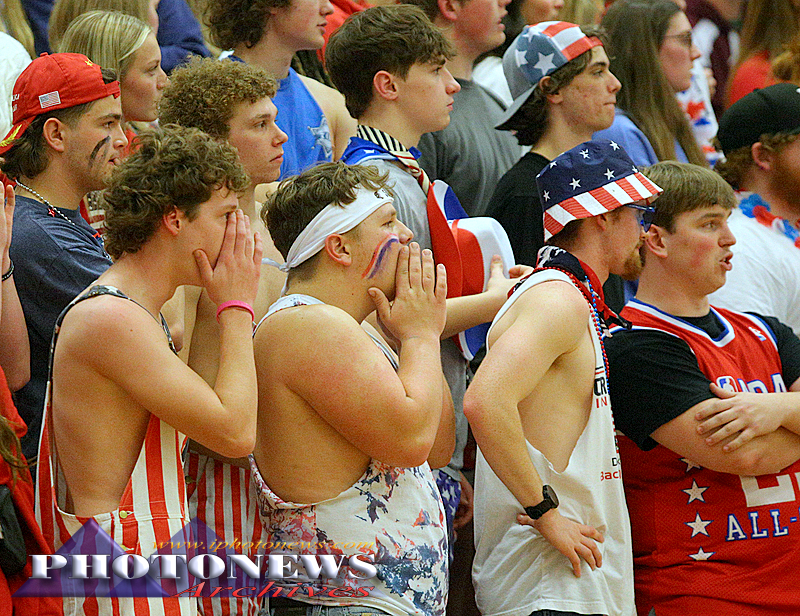
Unity (23-3) snagged the opening tip and it wasn't long before fans were forced to the edge of their seats by the 5's, Unity's Henry Thomas and SJO's Logan Smith. The two seniors, who later hugged after St. Joseph-Ogden (23-6) prevailed in the 73-72 overtime win, put on an impressive show of basketball skill, tenacity, and mental toughness. "This was a fun basketball game," said Unity head coach Matt Franks. "This is what high school basketball is all about. I thought it was a great atmosphere." Smith, who finished the contest with a game-high 29 points had five assists and three rebounds, drew first blood on a layup to momentarily put St. Joseph-Ogden in the lead on the scoreboard. St. Joseph-Ogden head coach Kiel Duval said players like Smith, with his mindset, are tough to beat. "It is tough to knock him down. He is an absolute winner," he said. "He has a 'refuse to lose' mentality. When you've got that, you are tough to beat." On the next two possessions, Thomas scored in the paint giving, and Dalton O'Neill added two more points on a reverse layup to give the Rockets a 6-2 lead. "Henry has worked really, really hard to get his game to where he can have a night like this," Frank said. Thomas finished the contest with a team-high 27 points and was four-for-eight from the charity stripe. Two Fridays earlier, the senior scored his 1,000th career point against Prairie Central at the Rocket Center. "I think it was a perfect combination of teammates moving the ball well so Henry can do what he does." The Spartans would even the score on two free throws from Luke Landus and a jumper from junior Coy Taylor, tying the game at six-all. After buckets from Unity's Tyler Henry and Eric Miebach, Andrew Thomas drains a trey, putting the Rockets up 13-6 with 1:20 left in the quarter. Flustered, the Spartans called a timeout. The Rockets continued to lead on the scoreboard until Smith knotted the game at 19-all. After converting a free throw, SJO takes a 20-19 lead. Unity shotmaking went cold after Coleton Langendorf hit his free throw to tie the game again at 20-all. Taking advantage of the lull, the Spartans make an 11-point run, going up 31-20. In control the rest of the first half through the first four minutes of the fourth quarter, SJO held a comfortable lead on their hosts until the last four minutes and 12 seconds of regulation time when Henry Thomas racked up eight points consecutive points, trimming his team's deficit from seven to two, 64-66. "We got into foul trouble and had some bad matchups," Duval explained. "Their best player got looks at the basket. Once we got into foul trouble, we had trouble recovering from that. We kind of went away from doing some of the stuff we did to get good looks." With 10.7 seconds left in the game, SJO's Tanner Jacob sinks the first of two free throws and misses the insurance basket. Unity gets the rebound and the ball down to Dane Eisenminger, who pumped a shot outside the arc in front of his team's bench. The trey falls with three seconds left in regulation time, sending the game into overtime at 67-all and the Rocket Center into an unabashed frenzy. Smith was the only player from either team to hit a field goal in overtime, helping St. Joseph-Ogden tallied six points against Unity's five to end one of the most exciting basketball games in the St. Joe-Unity rivalry. "Both teams played really hard," Franks said. "A game like this could have gone all night. It was great basketball." A free throw away from a second overtime, Franks said his game plan would have been to stay poised and composed if they had to go another session. "(We would) stay in the moment. It's all about the next possession, and we'd have to just focus on that," he said. "St. Joe is a great team, and it takes a great effort to beat them." Duval was expecting a dogfight and had no illusions, counting unhatched chickens. Earlier in the season, SJO suffered two losses in the last-second heartbreakers. The first in a non-conference game at Beecher 55-53, and the second on a buzzer-beater in the Small School Division State Farm Holiday Classic championship game to El Paso-Gridley. "There were two good teams battling back and forth. We knew they were going to throw another punch," he said. "They are at home. They always play better at home." Also contributing to SJO's scoring effort was Luke Landrus, who finished with 13 points, and Coy Taylor, 3-for-3 at the line, with 12 points. Tanner Siems had eight points, and Tanner Jacob drained a pair of treys and a free throw to finish with seven points. Andrew Thomas, Henry's twin, finished with 13 points, and Dalton O'Neill, who went five-for-six on free throws, contributed 12 points. Eric Meibach (9), Dane Eisenmenger (5), Jay Saunders (3), and Tyler Henry (2) contributed in the Rockets' effort. Coleton Langendorf hit a solo free throw for one point. "It was like a sectional championship game," Duval said, talking about the atmosphere. "That was huge. I am proud that our guys found a way to win."
Clash of the conference Titans; SJO outlasts Unity
Unity (23-3) snagged the opening tip and it wasn't long before fans were forced to the edge of their seats by the 5's, Unity's Henry Thomas and SJO's Logan Smith. The two seniors, who later hugged after St. Joseph-Ogden (23-6) prevailed in the 73-72 overtime win, put on an impressive show of basketball skill, tenacity, and mental toughness. "This was a fun basketball game," said Unity head coach Matt Franks. "This is what high school basketball is all about. I thought it was a great atmosphere." Smith, who finished the contest with a game-high 29 points had five assists and three rebounds, drew first blood on a layup to momentarily put St. Joseph-Ogden in the lead on the scoreboard. St. Joseph-Ogden head coach Kiel Duval said players like Smith, with his mindset, are tough to beat. "It is tough to knock him down. He is an absolute winner," he said. "He has a 'refuse to lose' mentality. When you've got that, you are tough to beat." On the next two possessions, Thomas scored in the paint giving, and Dalton O'Neill added two more points on a reverse layup to give the Rockets a 6-2 lead. "Henry has worked really, really hard to get his game to where he can have a night like this," Frank said. Thomas finished the contest with a team-high 27 points and was four-for-eight from the charity stripe. Two Fridays earlier, the senior scored his 1,000th career point against Prairie Central at the Rocket Center. "I think it was a perfect combination of teammates moving the ball well so Henry can do what he does." The Spartans would even the score on two free throws from Luke Landus and a jumper from junior Coy Taylor, tying the game at six-all. After buckets from Unity's Tyler Henry and Eric Miebach, Andrew Thomas drains a trey, putting the Rockets up 13-6 with 1:20 left in the quarter. Flustered, the Spartans called a timeout. The Rockets continued to lead on the scoreboard until Smith knotted the game at 19-all. After converting a free throw, SJO takes a 20-19 lead. Unity shotmaking went cold after Coleton Langendorf hit his free throw to tie the game again at 20-all. Taking advantage of the lull, the Spartans make an 11-point run, going up 31-20. In control the rest of the first half through the first four minutes of the fourth quarter, SJO held a comfortable lead on their hosts until the last four minutes and 12 seconds of regulation time when Henry Thomas racked up eight points consecutive points, trimming his team's deficit from seven to two, 64-66. "We got into foul trouble and had some bad matchups," Duval explained. "Their best player got looks at the basket. Once we got into foul trouble, we had trouble recovering from that. We kind of went away from doing some of the stuff we did to get good looks." With 10.7 seconds left in the game, SJO's Tanner Jacob sinks the first of two free throws and misses the insurance basket. Unity gets the rebound and the ball down to Dane Eisenminger, who pumped a shot outside the arc in front of his team's bench. The trey falls with three seconds left in regulation time, sending the game into overtime at 67-all and the Rocket Center into an unabashed frenzy. Smith was the only player from either team to hit a field goal in overtime, helping St. Joseph-Ogden tallied six points against Unity's five to end one of the most exciting basketball games in the St. Joe-Unity rivalry. "Both teams played really hard," Franks said. "A game like this could have gone all night. It was great basketball." A free throw away from a second overtime, Franks said his game plan would have been to stay poised and composed if they had to go another session. "(We would) stay in the moment. It's all about the next possession, and we'd have to just focus on that," he said. "St. Joe is a great team, and it takes a great effort to beat them." Duval was expecting a dogfight and had no illusions, counting unhatched chickens. Earlier in the season, SJO suffered two losses in the last-second heartbreakers. The first in a non-conference game at Beecher 55-53, and the second on a buzzer-beater in the Small School Division State Farm Holiday Classic championship game to El Paso-Gridley. "There were two good teams battling back and forth. We knew they were going to throw another punch," he said. "They are at home. They always play better at home." Also contributing to SJO's scoring effort was Luke Landrus, who finished with 13 points, and Coy Taylor, 3-for-3 at the line, with 12 points. Tanner Siems had eight points, and Tanner Jacob drained a pair of treys and a free throw to finish with seven points. Andrew Thomas, Henry's twin, finished with 13 points, and Dalton O'Neill, who went five-for-six on free throws, contributed 12 points. Eric Meibach (9), Dane Eisenmenger (5), Jay Saunders (3), and Tyler Henry (2) contributed in the Rockets' effort. Coleton Langendorf hit a solo free throw for one point. "It was like a sectional championship game," Duval said, talking about the atmosphere. "That was huge. I am proud that our guys found a way to win."
Commentary |
This Black History Month, fight for the freedom to learn
by Svante Myrick
A little over a year ago, the College Board unveiled its long-awaited draft AP African American Studies curriculum. What happened next was sad — and all too predictable.
Florida officials, led by Gov. Ron DeSantis, howled. They claimed the course “lacks educational value” and violated state laws against teaching about race and racism. The College Board initially caved to Florida’s demands and said the course would be heavily redacted, then said it wouldn’t.
At the end of 2023, it released the final version of the course, and it’s…better. But it’s still missing some important concepts. The new course omits any discussion of “structural racism” and makes studying the Black Lives Matter movement — modern Black history by any measure — optional.
That pretty much sums up the state of the fight against censorship and book-banning in this Black History Month: better, but still problematic.
On the plus side, the last few months have brought some very good news.
School board candidates endorsed by the pro-censorship group Moms for Liberty went down to resounding defeats last fall. After Illinois became the first state to prohibit book bans, several states — including Colorado, Kansas, Massachusetts, New Jersey, New Mexico, Washington, and Virginia — introduced their own anti-ban bills.
In December, two Black lawmakers, Reps. Ayanna Pressley (D-MA) and Maxwell Frost (D-FL), introduced bills in Congress aimed at fighting book bans. And a federal judge ruled that parts of an Iowa book ban were unenforceable.
But the censorship movement isn’t going away.
Moms for Liberty plans to start its own charter school in South Carolina. In other words, if you won’t let them ban books in your school, they’ll just start their own school. With your taxpayer money.
Meanwhile, librarians nationwide are being targeted by threats and harassment. And the propaganda outfit PragerU continues to pump out the offensive, woefully inaccurate junk it calls “edutainment” for public schools that will buy it.
So there’s still work to do.
Fortunately, the public is overwhelmingly on the right side of this issue. Poll after poll shows that Americans don’t support censorship and book bans in schools. Those of us who want children to have the freedom to learn are the majority.
We understand that kids are better prepared for life — and our country is better prepared to compete globally — when education is historically accurate and reflective of the diversity of our culture. We understand that book banning is un-American and censorship is a tool of dictators.
This majority needs to mobilize and be heard at the ballot box. The defeat of pro-censorship school board candidates in 2023 was a great start. Now we have to take that momentum into the local, state, and national elections this fall.
In the meantime, we also know that public pressure works. A public outcry got the College Board to change its plans for the African American Studies course. And when publisher Scholastic said it would segregate books about the Black and LGBTQ communities at its school book fairs, the public was outraged — and Scholastic reversed course.
Together, we have the power to stop the censors who want to whitewash our history and deprive kids of facts and stories that help them to understand our world. That applies to the Black experience in America, but also the experiences of LGBTQ people, Indigenous peoples, people of diverse faiths, immigrants, people with disabilities, and more.
Civil rights activists have pushed for decades for book publishers and educators to acknowledge and teach our full history, and to awaken our consciousness as a nation. We refuse to go backwards.
Black History Month is a great time for us to commit to using the power that we have to protect the freedom to learn. Our kids, and our country, will be better for it.
Svante Myrick serves as President and CEO of People For the American Way. Myrick garnered national media attention as the youngest-ever mayor of Ithaca, New York. This op-ed was distributed by OtherWords.org.
Smith puts on a superb show slipping Spartans past Unity
Leaving it on the floor, Rockets fall in OT
Packed house expected at the Rocket Center
Letter to the Editor |
Will Illinois lawmakers heed Oregon's failed experiment
David E. Smith, Executive Director
Illinois Family Institute
Commentary |
Appeals court rules against Trump, deciding presidents are not immune from prosecution
by Claire Wofford
Associate Professor of Political Science, College of Charleston
In a 57-page opinion issued on Feb. 6, 2024, a federal appeals court ruled against former President Donald Trump, deciding that presidents are not immune from criminal prosecution for actions they took while in office. The decision allows the federal prosecution of Trump for attempting to undermine the 2020 election to continue.
‘Divine right of kings’
Trump is the subject of multiple civil and criminal cases in both state and federal courts. He is currently appealing several of them, including one relating to his appearance on the Colorado ballot, which the Supreme Court has already agreed to hear. In mid-December 2023, the federal government asked the Supreme Court to weigh in on the immunity dispute as well, but the court declined to do so, at least until the appeal was heard by the U.S. Court of Appeals for the District of Columbia Circuit This particular case involves the prosecution of Trump by special counsel Jack Smith. On Aug. 1, 2023, Smith indicted Trump on four counts of violating federal law for his conduct relating to the 2020 election, including conspiracy to defraud the United States, conspiracy to obstruct an official proceeding, obstruction of and attempt to obstruct an official proceeding and conspiracy against rights. The proceeding in the appeals court was not about whether Trump committed these crimes but whether he could be prosecuted for them at all. Trump’s argument centered on a claim of presidential immunity – the notion that a president cannot be subjected to legal action for official conduct or actions taken as part of the job. While there is no explicit language in the U.S. Constitution about such immunity, the Supreme Court had previously ruled in Nixon v. Fitzgerald that presidents can be protected from civil lawsuits for their “official acts.” The Nixon decision did not control the outcome here, however, because that case involved a civil lawsuit rather than a criminal prosecution. As highlighted during the oral argument in Trump’s appeal, that distinction – of whether it’s a civil or criminal case – makes a world of difference. Protecting the president from the hassles of civil litigation is one thing; permitting the president, charged in Article 2 of the Constitution with faithful execution of the laws, to be able to break those same laws with impunity is quite another. That sort of upside-down world is precisely what led District Court Judge Chutkan to issue her sweeping ruling on Dec. 1, 2023, that presidents are not immune from prosecution for crimes committed while in office. As she put it, Trump did not have the “divine right of kings to evade criminal accountability.” The court today agreed with that sentiment.High stakes
The oral argument before the appeals court on Jan. 9, 2024, was similarly dramatic. The three judges spent over an hour rigorously questioning both sides, and the language was often sweeping. Trump’s lawyer spoke of a president’s need to take “bold and fearless” executive action, to not have to constantly “look over their shoulder” for fear of prosecution and of the “republic shattering” consequences of ruling against the former president. Judge Florence Y. Pan raised striking hypotheticals about presidents assassinating political opponents or selling national security secrets to foreign governments. The lawyer for the federal government noted the “frightening future” if presidents were free to violate the law while in office.
That principle, the appeals court panel wrote, “applies, of course, to a President.” The court’s Feb. 6, 2024, decision will have a substantial impact, at least until any final ruling is issued by the Supreme Court. Trump can be criminally prosecuted for the actions he took to overturn the 2020 election. Whether the case makes it to trial or results in a conviction, what happens to all the other pending cases involving Trump, and whether the former president is returned to the White House, are unanswered questions so far. The Supreme Court will surely be asked to provide some of those answers.“No man in this country is so high that he is above the law. No officer of the law may set that law at defiance with impunity. All the officers of the government, from the highest to the lowest, are creatures of the law and are bound to obey it.”
Commentary |
Could tackle football become a thing of the past? Flag football gaining popularity
by Josh Woods
Professor of Sociology, West Virginia University
One hundred years into the future, what if millions of people gathered every February, not to watch the Super Bowl, but to instead watch the annual world flag football championship? Once a casual activity played at family reunions, the competitive sport of flag football is “soaring,” “exploding” and “skyrocketing in popularity nationwide,” according to mainstream news outlets.
There’s some data behind the breathless headlines: According to the NFL’s official flag football program, since 2015 the number of kids ages 6 to 12 who play flag football has risen by 38%, to more than 1.5 million. In my recent book, “Emerging Sports as Social Movements,” I explore nontraditional sports like flag football and disc golf. One of my key findings is that splashy headlines about trendy sports rarely capture a sport’s true reach and staying power. For every sport like pickleball that gains widespread, sustained popularity, there are several – adventure racing, paintball and wakeboarding – that remain firmly ensconced in their niche. In the case of flag football, there are a handful of recent trends that truly do point to a promising future. But there are also some red flags that could end up hampering its growth.
A fun, fast, safer alternative
Though its rules are similar to tackle football, flag football is currently gaining attention for what makes it different. It’s considered a no-contact sport. A “tackle” involves snatching one of two flags that hang from the hips of the ball carrier. While players face injury risks, they sustain far fewer head impacts than athletes who play tackle football. With the public’s concerns about brain injuries on the rise, many parents are opting for flag football instead of tackle for their kids. Obscurity is a powerful barrier to emerging sports. But getting noticed may not be a problem for flag football. The International Olympic Committee announced in October 2023 that flag football would be headed to the Summer Games in Los Angeles in 2028. It’s not clear yet if active NFL players can compete, but if they are eligible – and if the U.S. assembles a “Dream Team” like the Olympic men’s basketball team of 1992 that included superstars Michael Jordan, Larry Bird and Magic Johnson – flag football could get on the radar of millions of casual sports fans in 2028. The Olympic version of flag football is fast-paced Games are shorter than a typical game of tackle football. Five players compete on 50-yard fields with 10-yard end zones for two 20-minute halves. This format made its first big appearance in the 2022 World Games in Birmingham, Alabama, where the U.S. men won gold and the women took home silver.The NFL cultivates the grassroots
Although it may come as a surprise, the NFL is embracing flag football and taking its growth seriously. In 2021, the NFL and Nike committed US$5 million in equipment to support high school flag football teams across the nation. The NFL’s official flag football program operates more than 1,600 local leagues and receives sponsorships from top brands like Visa, Gatorade and Subway. Most NFL teams are currently supporting the grassroots of flag football with summer camps, clinics and regional tournaments. During last year’s Super Bowl, an estimated 115 million viewers watched a flag football TV commercial featuring Mexican quarterback Diana Flores bobbing and spinning to evade NFL players and celebrities as they attempted to take her flag. On Feb. 4, 2024, the Pro Bowl – the NFL’s annual all-star game – sidelined tackle football for the second year in a row. In its place was a 7-on-7 flag football game that aired on ESPN and ABC and streamed on ESPN+. Prior to that game, on Feb. 2-3, the league also hosted the International NFL Flag Championships as part of the Pro Bowl Games, featuring young athletes from 12 countries.By the numbers
Flag football may be having a moment, but the question remains: Is the sport actually experiencing a meaningful surge in participation that could extend into the future? According to figures collected annually by the National Federation of High Schools, 21,980 students played high school flag football in 2023. To put this number in context, however, tackle football attracted 47 times more students – roughly 1 million players – the same year. Track and field, basketball and soccer have roughly 1 million participants apiece. Interest in flag football seems to be concentrated in a few regions, with roughly 80% of high school players living in just three states: Florida, Georgia and New York. Though high school participation in flag football has increased steadily since 2007, almost all the growth comes from the girls’ side.A nationwide sports participation survey finds that the number of casual players of flag football is up, but core participation is down. The study defines “casual players” as those who play fewer than 50 times per year, whereas “core players” participate 50 or more times each year. The share of Americans who play casually increased by 41% between 2016 and 2022. But core participation declined by 13% during this period. For sustainable growth, nontraditional sports need to generate excitement among both core and casual players. Top-down investments and marketing strategies may attract new players, but grassroots organizing keeps them coming back. Take pickleball. In recent years, the sport has generated plenty of cultural clout, with high-profile athletes like LeBron James investing in the professional circuit, and celebrity pickleball players making headlines. There has also been tremendous growth in pickleball’s social and physical infrastructure. For these reasons, both casual and core participation in pickleball more than doubled between 2016 and 2022.
Red sport, blue sport
In the end, the future of flag football may hinge on the public debate over tackle football’s safety. Over the past decade, several studies have found a link between repeated head impacts and the risk for serious brain injuries, including chronic traumatic encephalopathy, or CTE.
ADHD in adults, online quizzes may spread misconceptions and mis-self-diagnosis
by Matt SheehanOSF Healthcare
Risk of dementia is nearly three times higher the first year after a stroke
- The risk of dementia was highest in the first year after stroke, with a nearly 3-fold increased risk, then decreasing to a 1.5-fold increased risk by the 5-year mark and remaining elevated 20 years later.
- Dementia occurred in nearly 19% of stroke survivors over an average follow-up of 5.5 years.
- The risk of dementia was 80% higher in stroke survivors than in the matched group from the general population. The risk of dementia was also nearly 80% higher in stroke survivors than in the matched control group who had experienced a heart attack.
- The risk of dementia in people who had an intracerebral hemorrhage (bleeding in the brain) was nearly 150% higher than those in the general population.
Unity's All Out A Cappella show Feb. 16
TOLONO - The Unity Music Boosters are organizing an All Out A Cappella fundraiser on February 16th at the high school auditorium. The event will begin at 7 p.m. and will showcase performances from eight a cappella groups. The funds raised from the event will be used to support music programs in the Unit 7 school district. These programs include music trips, scholarships, costumes, risers, instrument repair and more. Your participation in this event will help to ensure the continued success of these programs.